Ingredients:
400 g skirt steak
6 soft tortillas
2 limes, juiced
2 tomatoes, diced
1 red onion, diced
1 clove garlic, very finely minced
1 bunch coriander, leaves picked
1 jalapeno, de-seeded, diced
1/2 cucumber, peeled, de-seeded and diced
2 tsp cumin seeds, ground
freshly ground white pepper
sea salt
peanut oil
Season steak all over with sea salt, freshly ground white pepper and cumin. Set aside for a half hour to come up to room temperature. Drizzle a little peanut oil over one side.
Pre-heat a fry pan over high flame. Cook steak, oiled side down, for one minute. Turn. Cook for a further minute. Drop heat to low. Cook for a minute. Turn and cook for a final minute, then set aside. Rest steak while you prepare the vegetables.
In a bowl, toss together the tomato, onion, garlic, coriander leaves, jalapeno and cucumber. Add the lime juice and a pinch of sea salt.
Warm tortillas according to packet instructions.
Slice the steak into small strips.
Fill tortilllas with steak and vegetables. Don't overfill, otherwise it'll go everywhere when you try and eat it.
Showing posts with label party food. Show all posts
Showing posts with label party food. Show all posts
Thursday, February 5, 2009

Friday, January 30, 2009
Goat kebabs with a spiced sour cream dipping sauce
Here's another recipe for goat kebabs. Again, to get the necessary boneless meat it's best to ask the butcher to bone out a whole leg and dice the remaining meat. Retain the bone for stock.
Ingredients:
200 g boneless goat meat, cut into a 1.5 cm dice
150 g sour cream
2 small chillies
2 cloves garlic, peeled
1/2 onion, cut into quarters with slices separated
a handful of cherry tomatoes, cut in half
2-3 tablespoons of fresh coriander (a mix of leaves and stems)
1 tbs whole cumin seeds, lightly roasted
freshly ground black pepper
sea salt
olive oil
Thread the goat, tomato and onion onto metal skewers (if you only have bamboo ones, you'll need to soak them in water prior to use to prevent burning). Season with freshly ground pepper, sea salt and olive oil. Refrigerate for a hour.
Pre-heat the broiler or barbecue to medium low. Cook the goat kebabs for 20-25 minutes or until cooked through, basting occasionally with a little oil.
Meanwhile, prepare the dipping sauce by blitzing the coriander, chilli, cumin and garlic in a food processor. Whisk in to sour cream. Season to taste with salt and black pepper.
Ingredients:
200 g boneless goat meat, cut into a 1.5 cm dice
150 g sour cream
2 small chillies
2 cloves garlic, peeled
1/2 onion, cut into quarters with slices separated
a handful of cherry tomatoes, cut in half
2-3 tablespoons of fresh coriander (a mix of leaves and stems)
1 tbs whole cumin seeds, lightly roasted
freshly ground black pepper
sea salt
olive oil
Thread the goat, tomato and onion onto metal skewers (if you only have bamboo ones, you'll need to soak them in water prior to use to prevent burning). Season with freshly ground pepper, sea salt and olive oil. Refrigerate for a hour.
Pre-heat the broiler or barbecue to medium low. Cook the goat kebabs for 20-25 minutes or until cooked through, basting occasionally with a little oil.
Meanwhile, prepare the dipping sauce by blitzing the coriander, chilli, cumin and garlic in a food processor. Whisk in to sour cream. Season to taste with salt and black pepper.
Goat kebabs with a sherry and paprika marinade
These are very simple kebabs. You could jazz them up with some fresh herbs, garlic, chilli powder or about anything else. Me, I couldn't really be bothered. I had some sherry I wanted to use up and wanted to do something dramatically different to the other lot of goat kebabs I'm doing today. You can barbecue them, broil them or even roast them. Either way, be careful not to overcook them. Goat meat is quite lean. It won't withstand as much punishment as, say, lamb. And yes, you can make these with lamb if you're unable to source goat. Could use mutton too, I suppose.
To get boneless goat me, I bought a whole goat leg. I asked the butcher to bone it out and cut it into a 1.5 cm dice.
Ingredients:
200 g boneless goat meat, cut into a 1.5 cm dice
125 mL dry sherry (no need to measure it, just eyeball it)
1/2 onion, cut into quarters with slices separated
a handful of cherry tomatoes, cut in half
1 tbs sweet paprika
a generous slash of sherry vinegar
a splash of olive oil
a freshly ground black pepper
sea salt
Thread the meat, tomato and onion onto skewers. If you're using bamboo skewers, you'll have to soak them in water prior to use to prevent burning. Me, I make things easier by using metal skewers. I picked up some nice, long ones for a couple of dollars at the local discount shop. Once the kebabs are prepared, sit them in an oven tray (you can use any tray, really, but I used an oven tray as it was just the right size). Season with black pepper and paprika, then add the sherry, sherry vinegar and olive oil. Cover and refrigerate for a couple of hours at least. Open the cling film every so often to spoon the liquid ingredients over the meat. Just before cooking, sprinkle generously with sea salt.
Cook on or under a medium-low heat for 20-25 minutes, turning and basting frequently with the marinade.
To get boneless goat me, I bought a whole goat leg. I asked the butcher to bone it out and cut it into a 1.5 cm dice.
Ingredients:
200 g boneless goat meat, cut into a 1.5 cm dice
125 mL dry sherry (no need to measure it, just eyeball it)
1/2 onion, cut into quarters with slices separated
a handful of cherry tomatoes, cut in half
1 tbs sweet paprika
a generous slash of sherry vinegar
a splash of olive oil
a freshly ground black pepper
sea salt
Thread the meat, tomato and onion onto skewers. If you're using bamboo skewers, you'll have to soak them in water prior to use to prevent burning. Me, I make things easier by using metal skewers. I picked up some nice, long ones for a couple of dollars at the local discount shop. Once the kebabs are prepared, sit them in an oven tray (you can use any tray, really, but I used an oven tray as it was just the right size). Season with black pepper and paprika, then add the sherry, sherry vinegar and olive oil. Cover and refrigerate for a couple of hours at least. Open the cling film every so often to spoon the liquid ingredients over the meat. Just before cooking, sprinkle generously with sea salt.
Cook on or under a medium-low heat for 20-25 minutes, turning and basting frequently with the marinade.
Friday, January 16, 2009
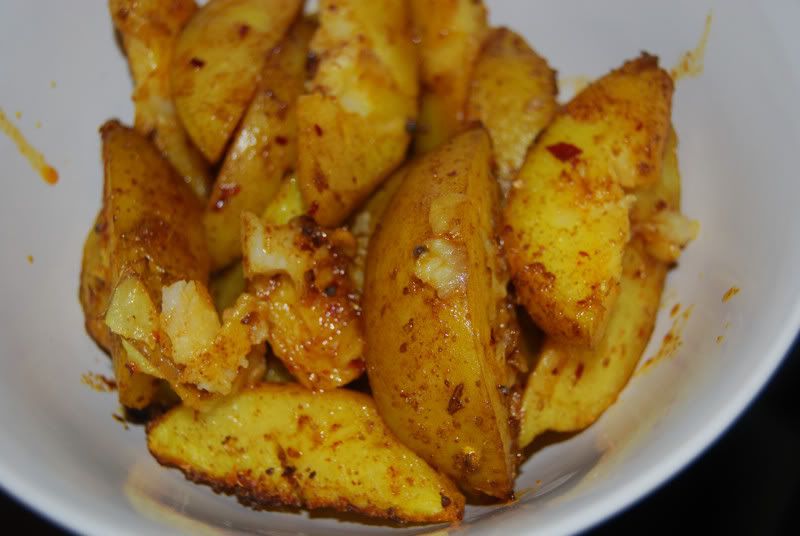
Potato wedges, Indian style
This twist on potato wedges isn't as loopy an idea as you may initially think. It was inspired by a recipe in one of my favourite cooking books, Camellia Panjabi's 50 Great Curries of India. This little book has done more than any other to increase my understanding of Indian cuisine and curries.
Anyway, enough praise for Ms. Panjabi's writings. She has a recipe for potatoes that are briefly boiled in turmeric-infused water and then fried in chilli- and coriander-infused oil. While her method of cooking is the undeniably more authentic way of preparing Indian 'potato wedges', I prefer to roast my potato wedges.
Ingredients:
500 g small potatoes, cut into wedges
4 cloves garlic, crushed
1 tsp chilli powder
1/2 tsp amchoor (mango powder)
1/2 tsp coriander, freshly ground
1/2 tsp garam masala
1/2 tsp hot curry powder
1/2 tsp mustard seeds
1/2 tsp sweet paprika
1/2 tsp turmeric powder
sea salt
oil
Pre-heat oven to 220*C.
Place the potatoes, tumeric and a pinch of sea salt in a saucepan. Add water to cover and bring to boil. Simmer for 7-8 minutes or until potatoes can be easily speared with a skewer.
Meanwhile, prepare the seasoning. Combine all of the spices, plus a little sea salt, in a cup or other small vessel. Lightly oil an oven tray and scatter the crushed garlic cloves over it. When the potatoes are able to be speared with a skewer, take them off the heat and drain. Add the potatoes to the tray. Toss in the oil and spice mix. Roast for 20-25 minutes, turning every so often.
Anyway, enough praise for Ms. Panjabi's writings. She has a recipe for potatoes that are briefly boiled in turmeric-infused water and then fried in chilli- and coriander-infused oil. While her method of cooking is the undeniably more authentic way of preparing Indian 'potato wedges', I prefer to roast my potato wedges.
Ingredients:
500 g small potatoes, cut into wedges
4 cloves garlic, crushed
1 tsp chilli powder
1/2 tsp amchoor (mango powder)
1/2 tsp coriander, freshly ground
1/2 tsp garam masala
1/2 tsp hot curry powder
1/2 tsp mustard seeds
1/2 tsp sweet paprika
1/2 tsp turmeric powder
sea salt
oil

Pre-heat oven to 220*C.
Place the potatoes, tumeric and a pinch of sea salt in a saucepan. Add water to cover and bring to boil. Simmer for 7-8 minutes or until potatoes can be easily speared with a skewer.
Meanwhile, prepare the seasoning. Combine all of the spices, plus a little sea salt, in a cup or other small vessel. Lightly oil an oven tray and scatter the crushed garlic cloves over it. When the potatoes are able to be speared with a skewer, take them off the heat and drain. Add the potatoes to the tray. Toss in the oil and spice mix. Roast for 20-25 minutes, turning every so often.
Tuesday, January 13, 2009
Buffalo meatballs with a mustard and pepper coating
Ingredients:
500 g buffalo sausages
1/4 cup flour
1 tbs mustard seeds, crushed
1 tsp powdered mustard
1 tsp freshly ground black pepper
1/2 tsp tumeric (optional--I use it purely for the colour)
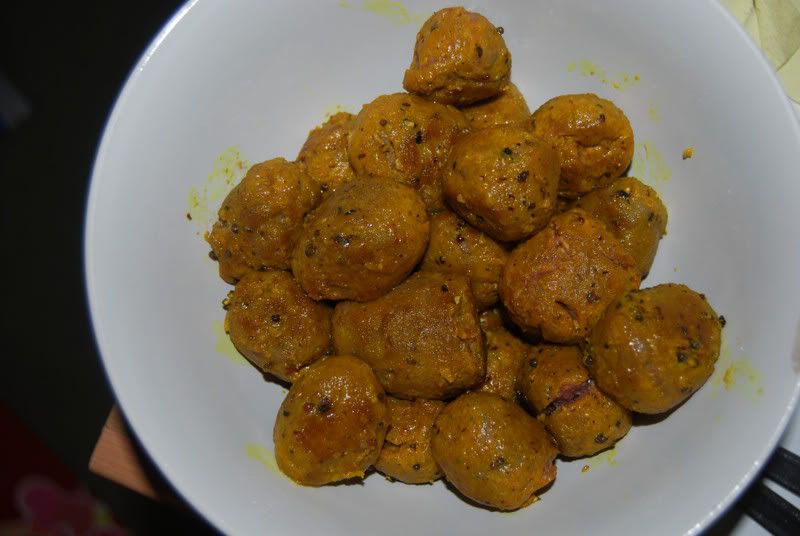
Combine everything but the sausages in a cup or other small vessel. Set aside.
Slit the sausage casings open with a paring knife. Extract the filling. Pull pieces of the filling off and roll into meatballs. Place in a bowl, add the seasoned flour and cover the bowl well with cling film. Shake until meatballs are evenly coated. Fry over a gentle heat until cooked though.
500 g buffalo sausages
1/4 cup flour
1 tbs mustard seeds, crushed
1 tsp powdered mustard
1 tsp freshly ground black pepper
1/2 tsp tumeric (optional--I use it purely for the colour)

Combine everything but the sausages in a cup or other small vessel. Set aside.
Slit the sausage casings open with a paring knife. Extract the filling. Pull pieces of the filling off and roll into meatballs. Place in a bowl, add the seasoned flour and cover the bowl well with cling film. Shake until meatballs are evenly coated. Fry over a gentle heat until cooked though.
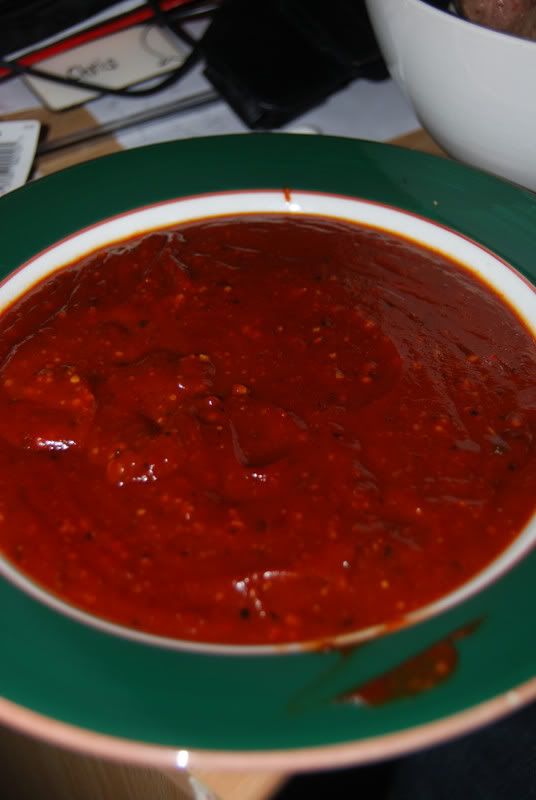
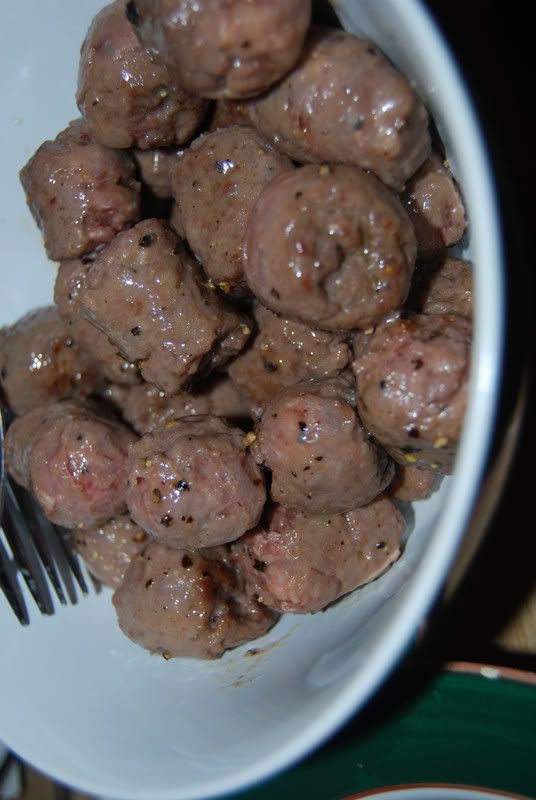
Buffalo meatballs with a spicy tomato and whisky dipping sauce
Ingredients:
500 g buffalo sausages
1 cup tomato ketchup
1/4 cup apple cider vinegar
1/4 cup whisky
2 tbs brown sugar
1 tbs Dijon mustard
1 tbs honey mustard
1 tbs sweet paprika
1 tbs chilli powder
1 tsp freshly ground allspice
1 tsp freshly ground cumin
1 tsp garlic powder
1 tsp onion powder
a generous grind of freshly ground black pepper
sea salt, to taste
Combine the tomato ketchup, apple cider, whisky, brown sugar, Dijon mustard, honey mustard, sweet paprika, chilli powder, allspice, cumin, garlic, onion powder, black pepper, sea salt and 1/4 cup of water in a small saucepan. Heat over a low flame until sauce starts to bubble. Simmer for 20 minutes, stirring frequently.
Meanwhile, prepare the meatballs by slitting open the sausage casings with a paring knife. Extract the filling and tear into portions. Roll each portion into a meatball. Fry over medium heat until cooked through.
500 g buffalo sausages
1 cup tomato ketchup
1/4 cup apple cider vinegar
1/4 cup whisky
2 tbs brown sugar
1 tbs Dijon mustard
1 tbs honey mustard
1 tbs sweet paprika
1 tbs chilli powder
1 tsp freshly ground allspice
1 tsp freshly ground cumin
1 tsp garlic powder
1 tsp onion powder
a generous grind of freshly ground black pepper
sea salt, to taste
Combine the tomato ketchup, apple cider, whisky, brown sugar, Dijon mustard, honey mustard, sweet paprika, chilli powder, allspice, cumin, garlic, onion powder, black pepper, sea salt and 1/4 cup of water in a small saucepan. Heat over a low flame until sauce starts to bubble. Simmer for 20 minutes, stirring frequently.

Meanwhile, prepare the meatballs by slitting open the sausage casings with a paring knife. Extract the filling and tear into portions. Roll each portion into a meatball. Fry over medium heat until cooked through.

Saturday, January 10, 2009
Crispy Cajun wings
I love chicken wings. A lot of flavour in them, with all that bone. They're fun to eat. And, yeah, they're cheap. A major selling point for a student. With all of the marinades I use, the wings themselves are prepared in exactly the same way. I use my chef's knife to lop off the wing tips, then I cut the wings in half at the joint. You can, of course, buy wingettes--wings that have already been portioned like that--but they're more expensive. The wings are cooked on the middle rack of the broiler for ten minutes aside on a medium-high heat. Ensure the bars of the grill are clean, to prevent sticking. You can also barbecue the wings.
This isn't a liquid marinade, obviously. Rather, it's a dry rub that comes out all crunchy. I only made this recently and, at present, I'm not 100% happy with it. I reckon turning the mix into a paste with rum or even halving the amount of mix and combining it with flour or quality bread crumbs would improve things greatly.
Take 2 tbs smoked paprika, 2 tbs sweet paprika, 3 tbs dried basil flakes, 2 tbs garlic powder, 2 tbs onion flakes, 2 tbs salt, 2 tbs freshly ground black pepper, 2 tbs ground fennel seeds, 3 tsp dried parsley, 3 tsp ground cinnamon, 3 tsp dried thyme, 2 tsp ground white pepper and 1 tsp chilli powder and combine. Rub into the wings.
This isn't a liquid marinade, obviously. Rather, it's a dry rub that comes out all crunchy. I only made this recently and, at present, I'm not 100% happy with it. I reckon turning the mix into a paste with rum or even halving the amount of mix and combining it with flour or quality bread crumbs would improve things greatly.
Take 2 tbs smoked paprika, 2 tbs sweet paprika, 3 tbs dried basil flakes, 2 tbs garlic powder, 2 tbs onion flakes, 2 tbs salt, 2 tbs freshly ground black pepper, 2 tbs ground fennel seeds, 3 tsp dried parsley, 3 tsp ground cinnamon, 3 tsp dried thyme, 2 tsp ground white pepper and 1 tsp chilli powder and combine. Rub into the wings.
Garlic, lemon and parsley wings
I love chicken wings. A lot of flavour in them, with all that bone. They're fun to eat. And, yeah, they're cheap. A major selling point for a student. With all of the marinades I use, the wings themselves are prepared in exactly the same way. I use my chef's knife to lop off the wing tips, then I cut the wings in half at the joint. You can, of course, buy wingettes--wings that have already been portioned like that--but they're more expensive. The wings are cooked on the middle rack of the broiler for ten minutes aside on a medium-high heat. Ensure the bars of the grill are clean, to prevent sticking. You can also barbecue the wings.
Take some fresh, flat leaf parsley and chop it finely. Combine it, some minced garlic and a good squeeze of lemon juice. Mix with olive oil.
Take some fresh, flat leaf parsley and chop it finely. Combine it, some minced garlic and a good squeeze of lemon juice. Mix with olive oil.
Peri peri wings
I love chicken wings. A lot of flavour in them, with all that bone. They're fun to eat. And, yeah, they're cheap. A major selling point for a student. With all of the marinades I use, the wings themselves are prepared in exactly the same way. I use my chef's knife to lop off the wing tips, then I cut the wings in half at the joint. You can, of course, buy wingettes--wings that have already been portioned like that--but they're more expensive. The wings are cooked on the middle rack of the broiler for ten minutes aside on a medium-high heat. Ensure the bars of the grill are clean, to prevent sticking. You can also barbecue the wings.
In a food processor, blitz a few fresh chillies, a little chilli powder and some garlic. Add lemon juice and lemon zest. Mix with olive oil.
Tip: you could also add some semi-dried tomato or use rice wine vinegar in place of olive oil.
In a food processor, blitz a few fresh chillies, a little chilli powder and some garlic. Add lemon juice and lemon zest. Mix with olive oil.
Tip: you could also add some semi-dried tomato or use rice wine vinegar in place of olive oil.
Louisiana chilli wings
I love chicken wings. A lot of flavour in them, with all that bone. They're fun to eat. And, yeah, they're cheap. A major selling point for a student. With all of the marinades I use, the wings themselves are prepared in exactly the same way. I use my chef's knife to lop off the wing tips, then I cut the wings in half at the joint. You can, of course, buy wingettes--wings that have already been portioned like that--but they're more expensive. The wings are cooked on the middle rack of the broiler for ten minutes aside on a medium-high heat. Ensure the bars of the grill are clean, to prevent sticking. You can also barbecue the wings.
A while ago I ordered a six pack of Louisiana-brand hot sauces from the online store USA Foods. They're all really nice and, yeah, I've done the natural thing of using them to marinate chicken wings. I combine equal parts red chilli hot sauce, chipotle hot sauce and roasted garlic hot sauce. The jalapeno one is nice too.
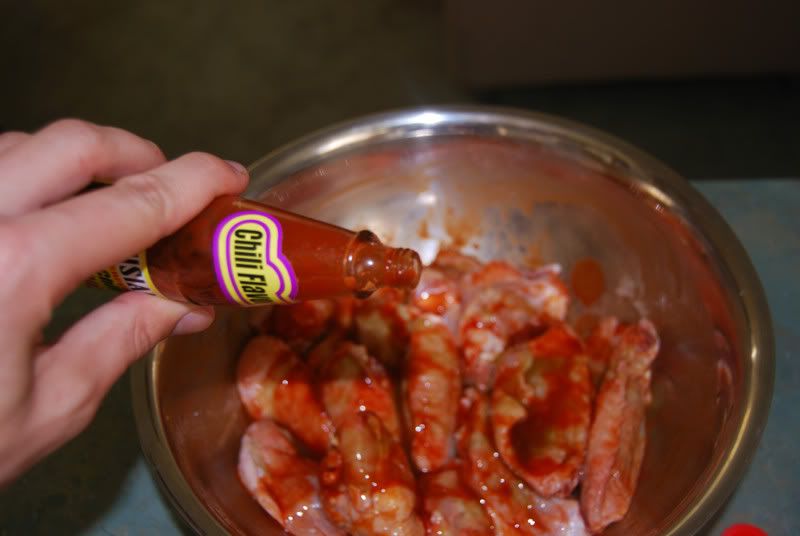
A while ago I ordered a six pack of Louisiana-brand hot sauces from the online store USA Foods. They're all really nice and, yeah, I've done the natural thing of using them to marinate chicken wings. I combine equal parts red chilli hot sauce, chipotle hot sauce and roasted garlic hot sauce. The jalapeno one is nice too.

Smokey Tabasco wings
With all of the marinades I use, the wings themselves are prepared in exactly the same way. I use my chef's knife to lop off the wing tips, then I cut the wings in half at the joint. You can, of course, buy wingettes--wings that have already been portioned like that--but they're more expensive. The wings are cooked on the middle rack of the broiler for ten minutes aside on a medium-high heat. Ensure the bars of the grill are clean, to prevent sticking. You can also barbecue the wings.
Cover the wings in maybe three or four tablespoons of Tabasco per kilogram, along with a teaspoon of chilli powder, a teaspoon of smoked paprika, a teaspoon of freshly ground black pepper and some sea salt. Rub everything into the wings. Allow to sit in the fridge, covered, for a couple of hours.
Tip: if you have a Middle Eastern, East African or South Asian grocery store nearby, duck in to see if they sell Rana brand chilli sauce. It's a Saudi-made sauce and tastes similar to Tabasco. The large bottles are about half the price of large bottles of Tabasco.
Cover the wings in maybe three or four tablespoons of Tabasco per kilogram, along with a teaspoon of chilli powder, a teaspoon of smoked paprika, a teaspoon of freshly ground black pepper and some sea salt. Rub everything into the wings. Allow to sit in the fridge, covered, for a couple of hours.
Tip: if you have a Middle Eastern, East African or South Asian grocery store nearby, duck in to see if they sell Rana brand chilli sauce. It's a Saudi-made sauce and tastes similar to Tabasco. The large bottles are about half the price of large bottles of Tabasco.
Friday, January 9, 2009
Crispy paprika chicken wings with a garlic and sherry sauce
There's a strong Spanish influence driving this recipe, as demonstrated by the garlic, the paprika and the sherry. I guess you could call it a tapas dish, even.
Ingredients:
1 kilogram chicken wings
200 mL dry sherry
4 garlic cloves, crushed
1 large shallot, diced
1 tbs salt
1 tbs smoked paprika
1 tbs sweet paprika
1 tsp chilli powder
1 tsp freshly ground black pepper
1 tsp freshly ground white pepper
olive oil
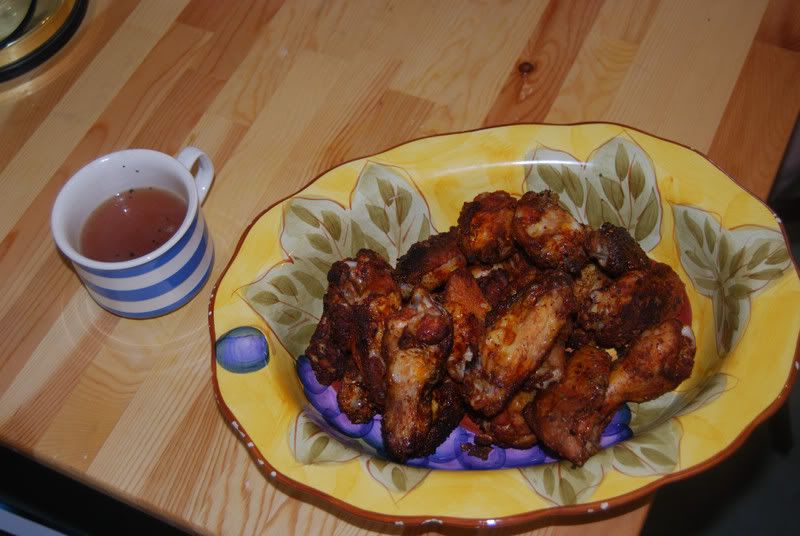
Prepare the chicken wings. Cut the tips off at the joint. Cut the wings into two 'wingettes' at the joint. Place in a bowl with the salt, smoked paprika, sweet paprika, chilli powder, black pepper and white pepper. Cover bowl with a couple of layers of cling film and shake vigourously to distribute the spices evenly. Refrigerate for a few hours or overnight.
Pre-heat the broiler to high. Ensure grill bars are clean. Cook chicken 'wingettes' under the broiler for twenty minutes, turning half way through.
Meanwhile, prepare the garlic and sherry sauce. In a small saucepan, heat some olive oil over a medium flame. Fry the garlic and shallot for ten minutes or until soft, stirring frequently. Add the sherry and stir. Bring to boil. reduce heat slightly and simmer for five minutes.
Ingredients:
1 kilogram chicken wings
200 mL dry sherry
4 garlic cloves, crushed
1 large shallot, diced
1 tbs salt
1 tbs smoked paprika
1 tbs sweet paprika
1 tsp chilli powder
1 tsp freshly ground black pepper
1 tsp freshly ground white pepper
olive oil

Prepare the chicken wings. Cut the tips off at the joint. Cut the wings into two 'wingettes' at the joint. Place in a bowl with the salt, smoked paprika, sweet paprika, chilli powder, black pepper and white pepper. Cover bowl with a couple of layers of cling film and shake vigourously to distribute the spices evenly. Refrigerate for a few hours or overnight.
Pre-heat the broiler to high. Ensure grill bars are clean. Cook chicken 'wingettes' under the broiler for twenty minutes, turning half way through.
Meanwhile, prepare the garlic and sherry sauce. In a small saucepan, heat some olive oil over a medium flame. Fry the garlic and shallot for ten minutes or until soft, stirring frequently. Add the sherry and stir. Bring to boil. reduce heat slightly and simmer for five minutes.
Sunday, January 4, 2009
Emu meatballs with a red wine dipping sauce

When I cooked emu for my students, once again I worked with the sausages. Emu has a strong, meaty taste. It stands up well to all of the sauces typically paired with red meats, including red wine jus. Emu sausages can be ordered in most butchers and poultry stores. If you're serving emu as a sit down dinner, it might be more appropriate to order a fan fillet. If you're serving the meatballs at some kind of function, though, simply jam a toothpick into each meat ball.
Ingredients:
1 kilogram emu sausages
3/4 cup red wine
1/4 cup beef or veal stock (either home made or quality store-bought stuff)
6 tbs unsalted butter, softened
2 shallots, finely diced
2 cloves garlic, crushed and minced
sea salt, to taste
freshly ground black pepper, to taste
Using a paring knife, slit sausages open and extract meat. Take a pinch of meat in your fingers and roll it into a ball. Season with salt and pepper, then repeat the process until you've used all the meat. Fry meatballs over a medium heat for 5-8 minutes or until cooked through.
Heat a tablespoon of butter in a fry pan. When hot, add shallots and garlic. Stir until soft and then add the red wine and stock. When the red wine and stock mixture starts to boil, drop the temperature and allow to simmer for a good 15-20 minutes. The volume should reduce by half, if not more. When wine and stock have reduced, whisk in the remaining butter a tablespoon at a time. Season with salt and pepper and remove from heat.
Buffalo meatballs with a spicy coating
This is a simple recipe I came up with when introducing both my students and myself to buffalo. I wanted something simple, something the kids and I could knock together in the space of a few minutes. I ended up settling on a spice rub. You can use this spice rub on buffalo steaks, but we used it on meatballs made from buffalo sausages. The sausages can be ordered at any good butcher or poultry store, although you'll find some places might have them kicking around the freezer already. The sausages, at least at the places I go, come frozen in a one kilogram pack.
1 kilogram pack buffalo sausages, thawed
1/4 cup plain flour
1 tbs sweet paprika
1 tbs allspice
1 tbs black pepper
1 tbs sea salt
1 tsp white pepper
1 tsp chilli powder
Use a paring knife to slit the sausages open. Peel the skin away from the meat. Take a pinch of meat and roll it into a meatball with your hands. Repeat until all of the sausages are gone.
In a cup or other small vessel, combine the flour and spices. Dip the meatballs into the seasoned flour one by one, rolling them around to ensure they get an even coating.
Heat some oil in a fry pan. Cook the meatballs over a medium flame for 5-8 minutes.
1 kilogram pack buffalo sausages, thawed
1/4 cup plain flour
1 tbs sweet paprika
1 tbs allspice
1 tbs black pepper
1 tbs sea salt
1 tsp white pepper
1 tsp chilli powder
Use a paring knife to slit the sausages open. Peel the skin away from the meat. Take a pinch of meat and roll it into a meatball with your hands. Repeat until all of the sausages are gone.
In a cup or other small vessel, combine the flour and spices. Dip the meatballs into the seasoned flour one by one, rolling them around to ensure they get an even coating.
Heat some oil in a fry pan. Cook the meatballs over a medium flame for 5-8 minutes.
Simple sushi rolls
Really good sushi is, well, really good. What makes really good sushi? Well, of course the fish has to be of good quality and fresh. And too, it has to be seasoned just right. And it has to be freshly made, so the nori--that is, the seaweed wrapping--remains crisp.
Now, you'll notice I don't specify sashimi-grade fish here. If you can get that, then by all means go nuts. But for the average person, any nice piece of fish will do the job. The term 'sashimi-grade' fish refers to how the fish was killed and stored. It's perfectly okay to use regular fish for sushi or sashimi. Indeed, I suspect many of the cheap sushi places around wouldn't use the expensive, sashimi-grade stuff.
I use salmon because raw salmon is one of my favourite things in the world. Feel free to use about anything else. If the fishmonger is telling you his tuna is really good today, then yeah, go for that instead. Anyway, with the salmon, I don't buy those cutlets. I get a fillet and pin bone it using a pair of tweezers. Invest in a dedicated pair of tweezers for pin-boning fish if you haven't already, as doing it by hand is a real pain.
To begin, steam some jasmine rice as normal. For a enough sushi for two people, I used two thirds of a cup of jasmine rice to just under one and a third cup of water. I added a little salt and brought it to a boil slowly, then dropped the heat and covered for twenty minutes. At the ten minute mark, I turned the heat off altogether. At the end of the twenty minutes, I removed the lid and fluffed it with a fork, before slowly adding some pre-mixed sushi seasoning (I picked up Mizkan brand from the local oriental grocer and it seemed okay), tasting and stirring as I went. I left the rice to cool while I prepared everything else.
I slice the fish about a centimetre thick. Too thin and it'll fall apart. I also julienned a spring onion and poured a little light soy sauce into a Chinese tea cup. Once the rice was about body temperature (about 37*C), I placed a sheet of nori on the bamboo sushi mat I'd picked up for all of a dollar. On top of the nori, I smeared a fairly thin layer of rice, although I left part bare.
Next, I layed, end to end, strips of spring onion. Then I took my finger and dipped it in the soy sauce. I smeared the sauce in a very thin film on one side of the fish. Be careful with soy sauce--use too much and you'll destroy the lovely flavour of the fish. Using your (clean) finger tip is perhaps the best way of applying it in this situation. I played the fish, soy side down, next to the slivers of spring onion. I put a few dots of wasabi paste on top of the fish. Never combine wasabi and soy sauce. And be sparing with the wasabi--people can add more later if they want, but if you use too much in the beginning you'll overpower the flavour of the fish. Finally, roll the sushi. Some people claim to have had trouble with this part, but for me it seemed simple enough. So long as you don't over pack it or use too much rice, you'll be fine. Eat as soon as possible, as it won't be long before the nori goes soggy.
Now, you'll notice I don't specify sashimi-grade fish here. If you can get that, then by all means go nuts. But for the average person, any nice piece of fish will do the job. The term 'sashimi-grade' fish refers to how the fish was killed and stored. It's perfectly okay to use regular fish for sushi or sashimi. Indeed, I suspect many of the cheap sushi places around wouldn't use the expensive, sashimi-grade stuff.
I use salmon because raw salmon is one of my favourite things in the world. Feel free to use about anything else. If the fishmonger is telling you his tuna is really good today, then yeah, go for that instead. Anyway, with the salmon, I don't buy those cutlets. I get a fillet and pin bone it using a pair of tweezers. Invest in a dedicated pair of tweezers for pin-boning fish if you haven't already, as doing it by hand is a real pain.
To begin, steam some jasmine rice as normal. For a enough sushi for two people, I used two thirds of a cup of jasmine rice to just under one and a third cup of water. I added a little salt and brought it to a boil slowly, then dropped the heat and covered for twenty minutes. At the ten minute mark, I turned the heat off altogether. At the end of the twenty minutes, I removed the lid and fluffed it with a fork, before slowly adding some pre-mixed sushi seasoning (I picked up Mizkan brand from the local oriental grocer and it seemed okay), tasting and stirring as I went. I left the rice to cool while I prepared everything else.
I slice the fish about a centimetre thick. Too thin and it'll fall apart. I also julienned a spring onion and poured a little light soy sauce into a Chinese tea cup. Once the rice was about body temperature (about 37*C), I placed a sheet of nori on the bamboo sushi mat I'd picked up for all of a dollar. On top of the nori, I smeared a fairly thin layer of rice, although I left part bare.
Next, I layed, end to end, strips of spring onion. Then I took my finger and dipped it in the soy sauce. I smeared the sauce in a very thin film on one side of the fish. Be careful with soy sauce--use too much and you'll destroy the lovely flavour of the fish. Using your (clean) finger tip is perhaps the best way of applying it in this situation. I played the fish, soy side down, next to the slivers of spring onion. I put a few dots of wasabi paste on top of the fish. Never combine wasabi and soy sauce. And be sparing with the wasabi--people can add more later if they want, but if you use too much in the beginning you'll overpower the flavour of the fish. Finally, roll the sushi. Some people claim to have had trouble with this part, but for me it seemed simple enough. So long as you don't over pack it or use too much rice, you'll be fine. Eat as soon as possible, as it won't be long before the nori goes soggy.
Camel meatballs with a mint/yoghurt sauce

Yeah, camel. Lovely stuff. In the northern parts of Australia, camels--an introduced species--are a real problem. So yeah, do your part for the environment and eat camel. Serious.
A lot of people I know, they wouldn't eat camel because, you know, 'eww'. But really, a chicken--even a free-range, organic one--is a dirty animal. Oysters, mussels and all those crustaceans--crabs and lobsters and bugs and yabbies--are all dirty animals. They're bottom feeders. So what's bad about a camel, really, in comparison?
For the curious, camel is, in flavour, a bit like mutton. Which, seeing as not many Westerners eat that any more, is like strong-flavoured lamb. The big difference between camel and mutton, though, is the aftertaste. Camel has this unique and wonderful sweet aftertaste. It's most apparent in the steaks, but here, in this recipe, we're using the sausages. Many butchers and poultry stores can order camel sausages, but you'll find that some places in the market have them kicking around in the freezer. When serving camel to a group as finger food, the sausages are brilliant.
Ingredients:
1 kilogram pack of camel sausages, fully thawed
250g Greek-style yoghurt
2 cloves of garlic, minced
1 Lebanese cucumber
a pinch of fresh mint leaves, finely chopped (more to taste)
a few drops of lemon juice (more to taste)
a little freshly ground black pepper (again, more to taste)
In a bowl, whisk together the yoghurt, crushed garlic, sea salt and a little of the mint. Take the cucumber, slice it in half lengthways and use a tiny spoon (I find one of those 1/2 teaspoon measuring spoons to be perfect for the task) to scoop out the seeds. Grate both halves of the cucumber into the yoghurt mix, whisk and taste. At this point, you might want to add a little mint. Don't just throw in a stupid amount, as fresh mint is very strong. Whisk in the lemon juice and a little freshly ground pepper. Cover the bowl and place it in the refrigerator for a while.
Take a sausage and, using a paring knife, slit the skin open. Peel the skin away and remove the meat. Take a good pinch of the meat and roll it into a ball. Repeat with the remaining sausages. Season with a little sea salt and black pepper, before pan frying over a medium flame until cooked. Don't overcook, as camel is quite lean.
To serve, simply jam a toothpick into each meatball, so people can dip it into the mint/yoghurt sauce.
Tips and ideas:
The sauce, of course, would go well with mutton or lamb or any meat, really, that has a similar flavour. Try it with goat, for instance. You could, of course, serve it with a grilled camel steak.
If you don't like mint and want to pair the camel with another sauce, well, be careful. The sweet aftertaste makes matching difficult. From experience I can tell you that mustard doesn't work at all. Consider something with rosemary. I can't say I've tried it, but I reckon it could work. Experiment, experiment, experiment.
Potato wedges
Yeah. Potato wedges. I make my own. Those frozen ones you buy, they're just crap, really. My potato wedges go well as a side for steak, but you could also serve them at a party as finger food.
First up, you need to buy the right kind of potato. Use Sebago potatoes. For the Australians reading this, the 'brushed potatoes' available at many supermarkets and green grocers are Sebago potatoes. Now, if you're serving these as a side, about one decent-sized potato per person is the way to go
Pre-heat the oven to 220*C.
Give the potatoes a good rinse and then slice them into wedges. Drop the wedges into a saucepan. Fill saucepan with enough water to cover the potatoes, add a pinch of sea salt and then bring to the boil over a medium-high flame. Reduce the temperature. Cook for maybe seven further minutes or until you can easily drive a skewer through the potatoes. Drain the potatoes and pour them into a roasting pan. Take care to pick a pan of the right size. The wedges shouldn't be piled on top of each other, yet at the same time there shouldn't be massive gaps between them. Toss the potato wedges in sea salt and freshly ground black pepper. Be generous. Throw three or four crushed garlic cloves into the pan, before tossing everything in a little olive oil. You could, if wanted to experiment, use a little duck fat instead. Certainly it's not worth buying some specially for potato wedges, of all things, but if you have some on hand you may as well give it a go.
Place the potato wedges in the oven for 25 minutes, removing regularly to turn and toss. Just before serving, give a final sprinkle of sea salt and black pepper.
First up, you need to buy the right kind of potato. Use Sebago potatoes. For the Australians reading this, the 'brushed potatoes' available at many supermarkets and green grocers are Sebago potatoes. Now, if you're serving these as a side, about one decent-sized potato per person is the way to go
Pre-heat the oven to 220*C.
Give the potatoes a good rinse and then slice them into wedges. Drop the wedges into a saucepan. Fill saucepan with enough water to cover the potatoes, add a pinch of sea salt and then bring to the boil over a medium-high flame. Reduce the temperature. Cook for maybe seven further minutes or until you can easily drive a skewer through the potatoes. Drain the potatoes and pour them into a roasting pan. Take care to pick a pan of the right size. The wedges shouldn't be piled on top of each other, yet at the same time there shouldn't be massive gaps between them. Toss the potato wedges in sea salt and freshly ground black pepper. Be generous. Throw three or four crushed garlic cloves into the pan, before tossing everything in a little olive oil. You could, if wanted to experiment, use a little duck fat instead. Certainly it's not worth buying some specially for potato wedges, of all things, but if you have some on hand you may as well give it a go.
Place the potato wedges in the oven for 25 minutes, removing regularly to turn and toss. Just before serving, give a final sprinkle of sea salt and black pepper.
The perfect prawns

I've seen a lot of prawn recipes that are very elaborate. And that's unfortunate as, really, prawns are nice enough to stand up on their own. So long as you buy good ones, I mean. Or have the facilities and the opportunity to catch them. So far as I'm concerned, you shouldn't bother working with prawns unless you can get fresh, local produce. Buy them on the day you plan on cooking them. Don't buy them on days when there's no way they could've been brought in fresh, like Sunday and Monday or after a public holiday. Don't buy the pre-cooked ones. They're rubbish. Don't buy the pre-shelled ones, either. They're terrible. When you're making a dish that only has a couple of ingredients, when you're allowing the ingredients to speak for themselves, the quality of your purchase is immediately apparent the moment you start eating. I mean, recently, a friend dropped by with a pile of prawns he picked up from one of the big supermarkets. In terms of freshness and quality, they paled in comparison to the prawns I picked up for less at one of the nearby Vietnamese fishmongers. Clearly, the customer base of the fishmonger is fussier than that of the average supermarket. Particularly during the summer holiday period, when many people are barbecuing.
So, yeah, buy good prawns, is the point. They need not be the most expensive, but they look and smell fresh. They shouldn't be all battered, physically. And they shouldn't smell too bad. If they smell kind of like a cleaning product, like ammonia, then refuse to buy them. If they smell really, really, really fishy, then yeah, don't buy them. If you're like me and live in a multicultural area, you'll probably have many butchers, fishmongers, delis, green grocers and spice stores within a reasonable distance of your home. Or if you live near one a fresh produce market, the same advice applies. Shop around.
Too, while you're out shopping, pick up some lemons. Seafood and lemon juice are a timeless and winning combination.
To prepare the prawns, take a sharp paring knife and drip the tip into the shell just behind the head. Carefully work your way along the prawn's 'spine' until you reach the tail. Now, gently pull the prawn open. You'll see an intestine. If the prawn's eaten lately, it'll be dark. Other times, it'll be a very pale green. It's very important you fish out the 'poo tube', as it does have a significant and negative impact on the taste of the flesh. Once you get used of the process of removing the 'poo tube', you'll be able to work your way through even a large pile of prawns in no time. This can be done ahead of time. Removing the 'poo tubes' of larger prawns is much easier than removing the 'poo tubes' of smaller prawns, so keep that in mind when shopping.
Place the freshly gutted prawns in a shallow bowl of olive oil. You can, if you want, add a crushed clove or two of garlic to the oil (remember the garlic oil will be even more flavoursome if you allow the garlic cloves to infuse in the oil overnight before adding the prawns). Cut the lemons into wedges. You're going to need them very soon.
When you're ready to cook, pre-heat a barbecue, grill pan or fry pan until the smoking point. Seriously, if you're using a pan, pre-heat it for a good five to ten minutes. Then add your prawns. Now, if you have a large amount of prawns, add only a few at a time. If you crowd the pan, the temperature will drop. Immediately squeeze lemon juice all over the prawns. Cook for maybe 45-60 seconds. Working quickly, flip the prawns over and squeeze more lemon juice over them. After 45-60 seconds, remove the prawns from the pan and place them on a serving platter.
And that's it. You can experiment, of course. If you really wanted, you could jam a thin sliver of chilli into the back of each prawn. You could add roughly chopped fresh parsley to the marinade, as they do in the MoVida cookbook. But whatever you do, keep in mind the whole point of the exercise is for people to be able to appreciate the lovely fresh prawns you've picked up. The last thing you want to do is to kill the flavour with a strong sauce or dressing.
Subscribe to:
Posts (Atom)

 Posts
Posts

