Showing posts with label crab. Show all posts

Saturday, February 21, 2009

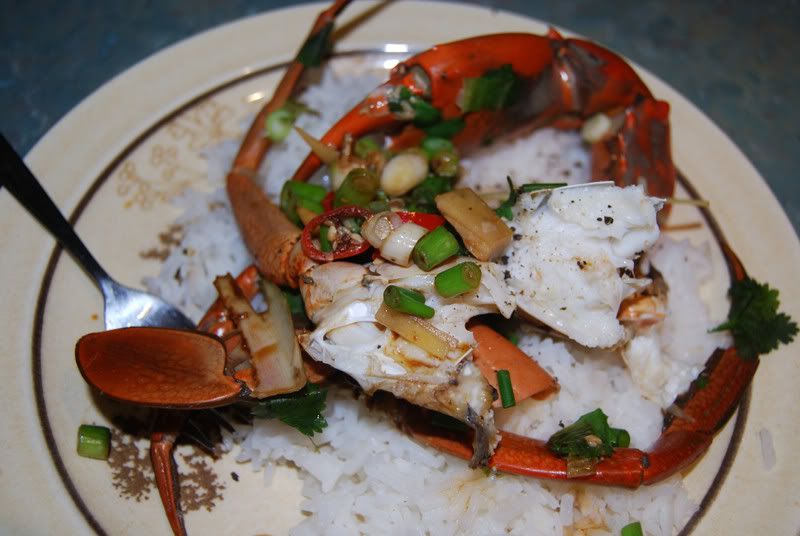
Thai mud crab


Never had mud crab before this. Had blue swimmer, had spanner. Didn't mind the former but wouldn't bother with the latter again. I was convinced that crab was inferior to bugs, yabbies, prawns and lobster, but still, I'd heard good things about mud crab and felt that I had to give it a go.

You might have to extend the cooking times. The crab I bought was about 600 g. A bigger crab would require a few more minutes, probably. You could use this recipe with other crabs. With blue swimmers, even. Just adjust the cooking time.


Ingredients:
1 live mud crab, about 600 g
4 cloves garlic, minced
3 stalks lemongrass, torn up and bruised
2 small chillies, sliced
1 big lump of ginger, sliced
1 bunch spring onions, sliced
1/2 bunch fresh coriander, leaves picked
a splash of soy sauce
a pinch of brown sugar
steamed rice, to serve

The best way of dealing with the crab is to sit it in the freezer for a hour. If he's not dead by that point, he'll be pretty groggy.

Heat a large saucepan of water on the stove. Sit an appropriately sized bamboo steamer over said saucepan. Meanwhile, take the crab from the freezer. Flip him onto his back and pull at the flap on the belly, ideally working off the shell in the process (if you balls it up, you can just bust the shell open with a sharp knife). Pick out the lungs--those grey, furry things--and get rid of the mustard-looking stuff. Pretty much, with a crab, the inedible stuff looks inedible. Twist the legs and claws off. Give the claws a good whack with the back of your knife, a meat tenderiser, a sharpening steel or pretty much anything to crack them open.


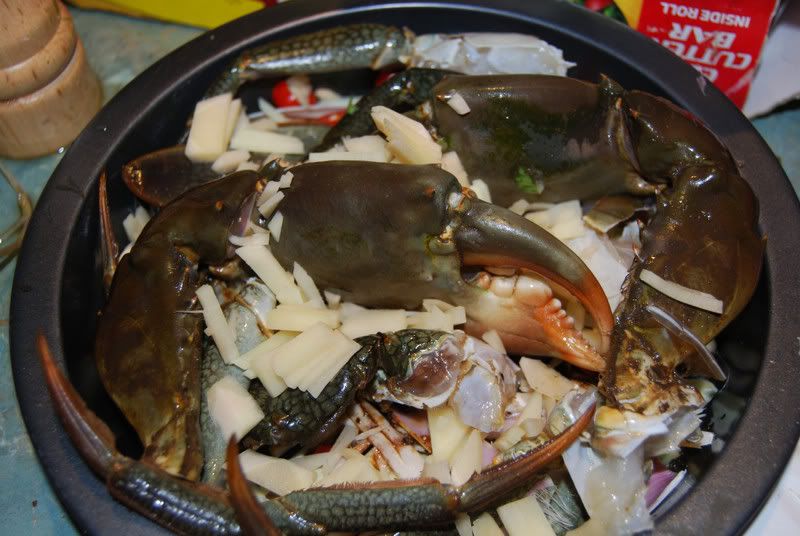
On a small metal plate (I actually used a small pie tin), make a bed for the crab pieces with the lemon grass. Scatter the garlic, ginger and chilli over the crab pieces. Sprinkle over the sugar and add the soy. Don't go nuts with that stuff, as it's pretty potent. Steam for 15 minutes or until the crab is cooked through--the shell will be bright red. Lift the lid of the steamer and scatter the coriander leaves and spring onion slices over the crab. Steam for a further minute. Serve with rice.

Thursday, January 22, 2009

The post-crab feast smell

I don't know about you, but I find the stench crabs leave in a stock pot after cooking rather offensive. Never fear, there is a way of dealing with this smell and it is very simple. All you have to do is give the stock pot a wash, then fill it up with water. Squeeze in some fresh lemon juice. Throw the lemon wedges in too. Put the stock pot somewhere out of the way so no 'helpful' soul decides to empty it. Leave overnight.

Thursday, January 15, 2009

Fishy smells and slime - a buyer's guide

Looking at my StatCounter page, I'm surprised at the amount of people Googling for things like, 'My steamed crab tastes like ammonia. That's okay, yeah?'

So. Some tips. Raw seafood should smell like the ocean. Fish, prawns, crabs and their brethren should look as if they've just been taken from the water. You've been fishing, right? Freshly caught fish don't smell overly 'fishy', do they? Fish bought at the shops shouldn't either. And they certainly shouldn't smell like cleaning products. Fish shouldn't be slimy, either.

I don't know about where you live, but I live close to a few fishmongers. If I ever walk in to a place and instantly feel my stomach turn because the place reeks to high heaven, I turn around and leave. Forget what the sales assistant says. If the seafood that's on display has a really strong smell, it's not fresh. Don't waste your money. Find another fishmonger.

In the case of crabs, lobsters and other crustaceans, try and find a fishmonger that sells them live. When crabs and lobsters die, they rapidly decompose. Something you kill immediately before or during the cooking process will taste better. Too, when you buy something live, you know it's fresh. When buying live crabs and lobsters, look for the ones that are really feisty. If they're just sulking at the bottom of the tank, pick another. Lobster and crab aren't cheap, generally, so be fussy. If a fishmonger is only selling rubbish, he doesn't deserve your money. Don't be so fixated on the idea of having lobster for dinner that you ignore the tell-tale signs of poor quality.

With prawns, buy whole, uncooked prawns. Buy whole fish in generally, really. It's easier to see if it's fresh. The eyes should be clear. And yeah, as I said, the fish should look as if it's just been pulled from the water. Note that some fishmongers will sell live fish--'live' as in they'll kill it to order. That's maybe the best way, aside from catching the fish yourself, of ensuring what you're buying is fresh.

With oysters, only buy them if you see them being shucked on site. Oysters will keep for about a week in the fridge, but they're better when they're freshly shucked. In the ideal world, you'd buy an oyster knife and learn to shuck them yourself.

Too, if you live in an area with a lot of oriental immigrants, consider yourself blessed. The Japanese, Chinese and Vietnamese eat a lot of seafood. There should be a lot of places catering to that market. Pay attention to what the grandmothers buy. If you see a few old biddies take one look at the snapper and walk away, shaking their heads in disgust, it's probably best to follow their lead and avoid the snapper.

There are too many terrible fishmongers around, foisting rubbish onto unsuspecting and ignorant customers. Whether you're intending on buying cheap, 'trash' fish like skate or premium stuff like lobsters and mud crabs, you must be fussy. Don't accept rubbish. If you get burnt by a business, don't give them a second chance. Surely someone else is more willing to provide you with quality produce.

Unless you're buying frozen seafood, when you buy is important. Never buy seafood on a Sunday, Monday or the day after a public holiday. Fishermen work from Monday to Friday. Friday's catch arrives in stores on Saturday morning. Therefore, what you buy on Monday arrived in store on Saturday morning. Yes, I know, some seafood--mussels, say--lasts 'a while' in the fridge, but the quality quickly deteriorates. As a rule, buy fresh seafood only on the day you're intending on using it.

When it comes to handling seafood, perhaps the most important thing to remember is to not wet the seafood. The last time fish should come into contact with water, unless you're poaching, is when they're taken out of the river or the sea. When filleting and gutting a fish, you should do it dry. Cleaning a fish the dry way is a slower process, but it produces better results. Washing out the gut cavity gets rid of all the natural oils in the fish's flesh. And those oils are flavour. Be wary of fishmongers who, when asked to clean a fish, hold the poor thing under running water while they work.

When pin boning fish fillets or cutlets, it's important to use tweezers. Your fingers will simply make a mess of the job. Dedicate a pair of tweezers to the task or buy a specialist pin boning tool. Some fish mongers may take care of this task for you.

Don't write off seafood that's frozen or somehow preserved. Crocodile, while arguably more game meat than seafood, is always sold frozen. Scampi is generally sold frozen. And it's fine. Really. Too, put aside your experiences with the canned seafood you've picked up in supermarkets in the past, as canned tuna from Spain is very good and works well as a filling in savoury pastries. Indeed, this is the same canned tuna used in tapas bars in Spain. That being said, most canned seafood is rubbish.

Monday, January 5, 2009

Steamed crabs with a simple lemon and pepper dipping sauce

Last night, I put together a crab curry with spanner crabs. I was disappointed. Spanner crabs, it turns out, have a worse meat to shell ratio than crabs I usually buy, the humble blue swimmers that readily available in about every Melbourne fishmonger. And too, the flavour of the gravy dominated the flavour of the meat. And yeah, I managed to stab myself on one of the crab's spines. So, yeah. Crabs. I like them, really, but only when they're prepared the right way. I've prepared them a few different ways now and, honestly? I really dig the way I first did them, when I first had them myself one Saturday with the kids. Whole lot of fun, that was.

Now, to cook crabs, I recommend steaming. The flavour of steamed crab is superior to that of boiled crab. I steam with salt water, but there's nothing stopping you using white wine or vermouth. Some folks use beer. I understand that flat beer imparts a better flavour. The best way to flatten beer is to pour it into a bowl and leave it to sit for a hour or so at room temperature.

So. Crabs. Buy the freshest ones you can get your hands one. The best way to ensure freshness is to buy live crabs, but sometimes the fishmongers don't have those or they're too expensive. So long as the blue swimmers at your local fishmonger have been killed recently, they'll be fine. Heck, ask your fishmonger if he can get some live ones in specially for you. He might be able to hook you up. Whether you buy male or female crabs is up to you. Female crabs sometimes have eggs. Male crabs are generally larger.

To steam the crabs in water, pour water to a couple of inches deep into a stock pot. Add salt until the water tastes like sea water. Crank the heat, bring up to the boil, add the crabs legs-up and jam the lid on. If using white wine or vermouth, heat the pan fry. When smoking, add a couple of inches of wine, add the crabs legs-up and jam the lid on. The general rule with crabs is to cook them for 15 minutes for the first 500 grams, followed plus an additional 10 minutes for every additional 500 grams. Now, that's just a general rule. The best way is to keep an eye on the things. When they're bright red all over, they're cooked. Pour the contents of the stock pot into a colander and hold the crabs under cold, running water. Not only does this arrest the cooking process, but it also makes them easier to handle and loosens the shell.

To deconstruct a crab, grab the claws at the base and give them a good twist to separate them from the body. Twist the legs off in a similar fashion. Somewhere on the underside of the crab you'll see a flap. Pull it towards you. Do it right and you'll take the top shell away with it. If you bugger it up, it's possible to prise the shell open with a knife in the same way you'd shuck an oyster.

Most of a crab's internals are edible, although you need to keep an eye out for small pieces of clear membrane amongst the meat. The only pieces you really can't eat are the stomach sac that's immediately behind the crab's 'face' and the grey, finger-like things on the crab's belly. I believe they're the lungs. Be sure to throw them away. Do hang onto the shell if you intend to knock up some seafood stock in the near future, though.

Eating crabs is meant to be a hands-on experience. Rather than taking all the fun out of it, simply serve your guests the claws and legs whole (although it is a good idea to crack the claws first--I used a meat mallet to do that). So far as hands-on lunches go, you really can't beat sucking crab meat from the legs and claws.

Oh and the dipping sauce. I almost forgot. This one can be whipped up while the crabs are steaming. It was shown to me by a Vietnamese friend. She simply squeezed the juice of a couple lemons into a bowl and gave it a liberal grind of black pepper and sea salt before mixing well with a fork. If you wanted to be creative, I suppose you could add a little fish sauce or chilli sauce. No need to be too fancy.