Ingredients:
4 pork chops
2 tsp white pepper, freshly ground
1 tsp smoked paprika
1 tsp dried basil
1 tsp garlic powder
1 tsp onion flakes
1 tsp salt
1 tsp dried parsley
1 tsp dried thyme
1/2 tsp chilli powder
1/4 tsp cinnamon, ground
a little bourbon
Ensure all spices are very finely ground. Combine in a cup or other small vessel. Add just enough bourbon to form a thick paste. Rub this into the pork. Set aside for a hour. Barbecue or broil until cooked through.
Showing posts with label pork. Show all posts
Showing posts with label pork. Show all posts
Wednesday, February 4, 2009

Wednesday, January 14, 2009
Bolognese sauce
For most Australians, Bolognese sauce contains a single meat product--beef mince. True Bolognese sauce, though, contains at least two. The recipe below was inspired by a recipe I dug up that purported to be as authentic as they come. It contained beef mince, pork mince, sausage, panchetta and ham. Curiously, it didn't have any basil or garlic--ingredients many of us consider very Italian. It was interesting to see how different this recipe was from what I'd grown up with. My dad--not an Italian--regularly made Bolognese with spaghetti. Indeed, it was the only thing he knew how to cook. It was different, even, from some of the more 'modern' versions I've seen whipped up by Maggie Beer and Jamie Oliver. It was interesting, to be sure, but I couldn't help but feel that some of those 'modern' touches were needed. So, off the top of my head, I can tell you that the idea of including a diced chilli comes from Mr. Oliver. I saw him do it and thought, yeah, it needed to be done. The chicken livers came from Maggie Beer. She reckons they add a lot to the flavour and aroma of the sauce and she's right. The veal and beef combo? Well, I'll claim that as my own. Having veal in addition to beef, instead of just beef, adds to the complexity of the flavour of the sauce. Feel free to substitute the 200 g of veal with a further 200 g of beef, though. As for the garlic, well, to me, as a non-Italian, as someone who's grown up on Australianised Bolognese, excluding garlic of all things seems sinful. And the basil? Same thing, really.
The quantities below make for a lot of sauce. Don't worry, this stuff keeps well in the fridge (2-3 days) and freezer (2 months) Indeed, it's even better on the second day.
Ingredients:
250 g pork mince
200 g beef mince
200 g veal mince (substitute with more beef mince if you must)
200 g chicken livers
200 g tomato paste
100 g panchetta, diced
50 g ham, diced
2 cups (500 mL) beef stock
3/4 cup (185 mL) red wine
4 cloves of garlic, diced
3 dried bay leaves, crumbled
2 sticks of celery, diced
1 carrot, diced
1 chilli, diced (seeds removed)
1 Italian pork sausage, roughly chopped
1 onion, diced
handful of fresh basil leaves, roughly chopped
a touch of freshly grated nutmeg
a grind of black pepper
sea salt
In a saucepan, fry the panchetta until crispy. Remove from pan and set aside.
Fry the chicken livers until they've got a bit of colour--perhaps 30 seconds--and then set them aside to cool. When they're cool, roughly chop them.
Give the saucepan a clean, if need be, and then fry the carrot, celery, chilli, garlic and onion until they begin to soften. At this point, add the sausage and mince. Fry until mince has a bit of colour. Return the liver and panchetta to the saucepan.
Add the wine. Stir. Add the tomato paste. Fry for a further 4 minutes, then add the beef stock, along with a little nutmeg, the basil leaves and the bay leaves. When sauce starts to bubble, reduce heat and cover. Simmer for a hour, removing the lid occasionally to stir. When the hour is up, remove the lid. Simmer, stirring occasionally, for a further 30 minutes. Then add the ham. Simmer for 30 more minutes then allow to cool.
If you're planning on making spaghetti Bolognese, heat some of the sauce over a low flame in a saucepan while cooking some spaghetti. The general rule is 80-100 g of pasta per person. Dress with a few basil leaves and a splash of extra virgin olive oil.
The quantities below make for a lot of sauce. Don't worry, this stuff keeps well in the fridge (2-3 days) and freezer (2 months) Indeed, it's even better on the second day.
Ingredients:
250 g pork mince
200 g beef mince
200 g veal mince (substitute with more beef mince if you must)
200 g chicken livers
200 g tomato paste
100 g panchetta, diced
50 g ham, diced
2 cups (500 mL) beef stock
3/4 cup (185 mL) red wine
4 cloves of garlic, diced
3 dried bay leaves, crumbled
2 sticks of celery, diced
1 carrot, diced
1 chilli, diced (seeds removed)
1 Italian pork sausage, roughly chopped
1 onion, diced
handful of fresh basil leaves, roughly chopped
a touch of freshly grated nutmeg
a grind of black pepper
sea salt
In a saucepan, fry the panchetta until crispy. Remove from pan and set aside.
Fry the chicken livers until they've got a bit of colour--perhaps 30 seconds--and then set them aside to cool. When they're cool, roughly chop them.
Give the saucepan a clean, if need be, and then fry the carrot, celery, chilli, garlic and onion until they begin to soften. At this point, add the sausage and mince. Fry until mince has a bit of colour. Return the liver and panchetta to the saucepan.
Add the wine. Stir. Add the tomato paste. Fry for a further 4 minutes, then add the beef stock, along with a little nutmeg, the basil leaves and the bay leaves. When sauce starts to bubble, reduce heat and cover. Simmer for a hour, removing the lid occasionally to stir. When the hour is up, remove the lid. Simmer, stirring occasionally, for a further 30 minutes. Then add the ham. Simmer for 30 more minutes then allow to cool.
If you're planning on making spaghetti Bolognese, heat some of the sauce over a low flame in a saucepan while cooking some spaghetti. The general rule is 80-100 g of pasta per person. Dress with a few basil leaves and a splash of extra virgin olive oil.
Monday, January 12, 2009
Beef and pork burger
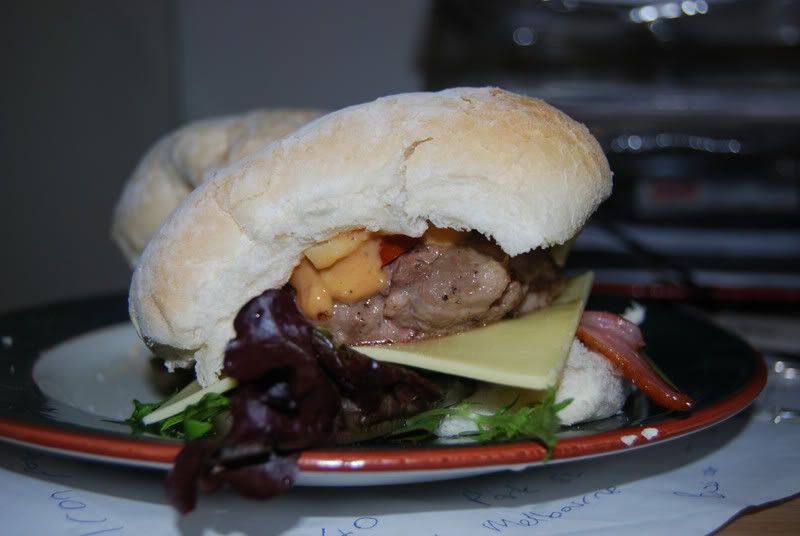
Combining beef and pork mince in the one burger is a very good idea. For starters, it's a flavoursome combination. And too, the pork mince is or at least should be fatty. Fattier than the beef mince. That fat, that glorious fat, will keep the patties moist as you cook them.
Ingredients:
200 g beef mince
200 g pork mince
4 slices Swiss cheese
4 small slices of rindless bacon
4 good quality rolls, opened
2 cloves garlic, finely minced
1 tomato, sliced and seasoned with sea salt and freshly ground black pepper
1/2 red onion, finely diced
handful mixed lettuce leaves
1 tbs Dijon mustard
1 tbs tomato ketchup
freshly ground black pepper, to taste
sea salt, to taste
Tabasco sauce, to taste
olive oil
The day before, combine the beef mince, pork mince and minced garlic. Add freshly ground black pepper, sea salt and Tabasco sauce to taste. Form seasoned mince into four patties and place on a plate. Use your thumb to make an indentation in the top of each patty. Cover with cling film and refrigerate overnight.
Make the sauce by combining the Dijon mustard, tomato ketchup and onion. Season to taste with sea salt and freshly ground black pepper.
Season the tomato slices with a little sea salt and freshly ground black pepper.
Fry the patties over a medium-low flame. When liquid starts to pool on top, flip them carefully. The secret to keeping patties in one piece isn't to add saw dust (i.e. supermarket-bought bread crumbs) or egg. It's thus--don't add that'll reduce their structural integrity (i.e. onion), refrigerate for a few hours or overnight once formed and cook slowly.
Meanwhile, lightly toast the burger buns under the broiler. When buns are toasted, increase the temperature of the broiler and add the slices of bacon. Drizzle a little olive on them and broil until crispy.
Place the lettuce on the lower bun, then add, in the following order, the bacon, the cheese, the beef and pork patty, the tomato and a spoonful of sauce.

Ingredients:
200 g beef mince
200 g pork mince
4 slices Swiss cheese
4 small slices of rindless bacon
4 good quality rolls, opened
2 cloves garlic, finely minced
1 tomato, sliced and seasoned with sea salt and freshly ground black pepper
1/2 red onion, finely diced
handful mixed lettuce leaves
1 tbs Dijon mustard
1 tbs tomato ketchup
freshly ground black pepper, to taste
sea salt, to taste
Tabasco sauce, to taste
olive oil
The day before, combine the beef mince, pork mince and minced garlic. Add freshly ground black pepper, sea salt and Tabasco sauce to taste. Form seasoned mince into four patties and place on a plate. Use your thumb to make an indentation in the top of each patty. Cover with cling film and refrigerate overnight.
Make the sauce by combining the Dijon mustard, tomato ketchup and onion. Season to taste with sea salt and freshly ground black pepper.
Season the tomato slices with a little sea salt and freshly ground black pepper.
Fry the patties over a medium-low flame. When liquid starts to pool on top, flip them carefully. The secret to keeping patties in one piece isn't to add saw dust (i.e. supermarket-bought bread crumbs) or egg. It's thus--don't add that'll reduce their structural integrity (i.e. onion), refrigerate for a few hours or overnight once formed and cook slowly.
Meanwhile, lightly toast the burger buns under the broiler. When buns are toasted, increase the temperature of the broiler and add the slices of bacon. Drizzle a little olive on them and broil until crispy.
Place the lettuce on the lower bun, then add, in the following order, the bacon, the cheese, the beef and pork patty, the tomato and a spoonful of sauce.
Tuesday, January 6, 2009
Barbecue pork pizza
Following on from yesterday's post about making the perfect pizza base in a domestic oven, I figured I'd provide a suggestion for a topping combination. Remember that pizza has few rules. Once you perfect the base, you're free to experiment with the toppings. I mean, just because the local takeaway doesn't put a particular ingredient on a pizza doesn't mean you can't.
The recipe for the perfect pizza, along with the associated 'rules' for pizza making, can be found here.
Ingredients:
1 ball of pizza dough (see original article)
75 mL tomato passata (aka sugo)
8 thin slices salami
5 balls of boccocini cheese, sliced
2 good quality pure pork sausages
2 slices pan-sized bacon, diced
1 onion, sliced
splash of Worcester sauce
freshly ground black pepper
sea salt
Use a paring knife to slit the sausage skin. Extract the meat. Take pinches of the meat and roll it into meatballs. Season meatballs with salt and pepper and pan fry, along with bacon, until cooked through. Set aside to cool.
Pre-heat the oven to 230*C for a good twenty minutes, as per usual. When ready to cook, remove stone slab/oven tray from oven and drop the oven temperature to 200*C. Roll the base out directly onto the slab/tray, dusting the slab/tray with corn flour if you feel it necessary. Roll the pizza base about 7 millimetres thick. If you roll it too thin, it won't come out as well as it should.
Combine tomato passata with a generous splash of Worcester sauce. Spread the passata over the pizza. Distribute the sliced boccocini cheese evenly across the base. Top with pork meatballs, salami, bacon and onion. Bake pizza for 20 minutes or until base is crispy and golden.
The recipe for the perfect pizza, along with the associated 'rules' for pizza making, can be found here.
Ingredients:
1 ball of pizza dough (see original article)
75 mL tomato passata (aka sugo)
8 thin slices salami
5 balls of boccocini cheese, sliced
2 good quality pure pork sausages
2 slices pan-sized bacon, diced
1 onion, sliced
splash of Worcester sauce
freshly ground black pepper
sea salt
Use a paring knife to slit the sausage skin. Extract the meat. Take pinches of the meat and roll it into meatballs. Season meatballs with salt and pepper and pan fry, along with bacon, until cooked through. Set aside to cool.
Pre-heat the oven to 230*C for a good twenty minutes, as per usual. When ready to cook, remove stone slab/oven tray from oven and drop the oven temperature to 200*C. Roll the base out directly onto the slab/tray, dusting the slab/tray with corn flour if you feel it necessary. Roll the pizza base about 7 millimetres thick. If you roll it too thin, it won't come out as well as it should.
Combine tomato passata with a generous splash of Worcester sauce. Spread the passata over the pizza. Distribute the sliced boccocini cheese evenly across the base. Top with pork meatballs, salami, bacon and onion. Bake pizza for 20 minutes or until base is crispy and golden.
Sunday, January 4, 2009
'Boerewors' pot pie
Boerewors is a heavily spiced South African sausage. Some contain only beef, but my favourite variety includes the ingenious combination of beef, pork and bacon. It wasn't long after I first had this variety of boerewors that I was inspired to make a pie using the same spices and meats. Because I have little patience for pastry at the best of times, it'd be a pot pie. That being said, if you want to create a short crust base or create 'party pies' in a muffin tin, go right ahead. I'll eventually get around to doing the later, as I'd like to be able to give my girlfriend something nice to take to work for lunch.
Too, you might've noticed that there's a lot of coriander (cilantro) in this dish. South Africans love their coriander. Don't worry about it if you're not the greatest fan of the stuff, though, as the flavour of the spices will mellow considerably during cooking.
400 grams each of pork and beef (for the beef, go for chuck steak or stewing steak), cut into 2-3 centimetre cubes
100 grams of bacon, diced (you can also use the more expensive spek)
4 tbs freshly ground coriander
2 tbs sea salt
1 tbs freshly ground black pepper
1/2 tsp freshly ground nutmeg
1/2 tsp freshly ground allspice
1/4 tsp freshly ground cloves
500mL beef stock (if you haven't made your own, at least spend a little extra to get good quality stuff)
2 small onions or one large one, sliced
a couple of springs of fresh thyme
a couple of cloves of garlic, crushed
a generous splash of Worcester sauce
a splash of red wine vinegar
a splash of brandy or cognac
a generous pinch of corn flour
an egg, beaten
a splash of milk
a sheet of store-bought puff pastry, thawed
Combine the dried spices in a bowl. Rub into the cubes of pork and bacon. Place in the fridge for a few hours, covered.
On a low flame, heat a little oil in a large saucepan. Fry the garlic and onion, stirring constantly. When they start to soften, add the pork and beef and seal them lightly. Once sealed, add a splash of brandy, a splash of red wine vinegar and a generous splash of Worcester sauce. Let it sizzle away for a moment and then add the beef stock. Add the diced bacon and a couple of springs of fresh thyme. Simmer on a very low heat, partly covered, for a couple of hours or until the meat is very tender. Season with extra salt, pepper and Worcester sauce if you feel it necessary. Remove the springs of thyme and add a generous pinch of corn flour. Stir it in and remove the saucepan from the heat. The 'stew' won't thicken immediately, so don't keep adding corn flour under the assumption you haven't used enough--it'll thicken as it cools. It's possible and, indeed, preferable to make the filling the day before you serve the pie.
Pre-heat the oven to 180*C. Pour the cooled filling into a pie pan. It should be thick. If it's quite obviously too thick, add a little splash of stock. Place the pastry sheet over the pie pan, ensuring you it is completely covered. Trim off any excess pastry. Use a skewer or the tip of a paring knife to prick a few holes in the pastry--this will allow the steam to escape. Finally, combine the milk and the beaten egg in a cup or other small vessel. Using a pastry or basting brush, brush the milk/egg wash all over the pastry. Place the pie in the oven for 20-30 minutes or until the pastry has turned crispy and golden.
Too, you might've noticed that there's a lot of coriander (cilantro) in this dish. South Africans love their coriander. Don't worry about it if you're not the greatest fan of the stuff, though, as the flavour of the spices will mellow considerably during cooking.
400 grams each of pork and beef (for the beef, go for chuck steak or stewing steak), cut into 2-3 centimetre cubes
100 grams of bacon, diced (you can also use the more expensive spek)
4 tbs freshly ground coriander
2 tbs sea salt
1 tbs freshly ground black pepper
1/2 tsp freshly ground nutmeg
1/2 tsp freshly ground allspice
1/4 tsp freshly ground cloves
500mL beef stock (if you haven't made your own, at least spend a little extra to get good quality stuff)
2 small onions or one large one, sliced
a couple of springs of fresh thyme
a couple of cloves of garlic, crushed
a generous splash of Worcester sauce
a splash of red wine vinegar
a splash of brandy or cognac
a generous pinch of corn flour
an egg, beaten
a splash of milk
a sheet of store-bought puff pastry, thawed
Combine the dried spices in a bowl. Rub into the cubes of pork and bacon. Place in the fridge for a few hours, covered.
On a low flame, heat a little oil in a large saucepan. Fry the garlic and onion, stirring constantly. When they start to soften, add the pork and beef and seal them lightly. Once sealed, add a splash of brandy, a splash of red wine vinegar and a generous splash of Worcester sauce. Let it sizzle away for a moment and then add the beef stock. Add the diced bacon and a couple of springs of fresh thyme. Simmer on a very low heat, partly covered, for a couple of hours or until the meat is very tender. Season with extra salt, pepper and Worcester sauce if you feel it necessary. Remove the springs of thyme and add a generous pinch of corn flour. Stir it in and remove the saucepan from the heat. The 'stew' won't thicken immediately, so don't keep adding corn flour under the assumption you haven't used enough--it'll thicken as it cools. It's possible and, indeed, preferable to make the filling the day before you serve the pie.
Pre-heat the oven to 180*C. Pour the cooled filling into a pie pan. It should be thick. If it's quite obviously too thick, add a little splash of stock. Place the pastry sheet over the pie pan, ensuring you it is completely covered. Trim off any excess pastry. Use a skewer or the tip of a paring knife to prick a few holes in the pastry--this will allow the steam to escape. Finally, combine the milk and the beaten egg in a cup or other small vessel. Using a pastry or basting brush, brush the milk/egg wash all over the pastry. Place the pie in the oven for 20-30 minutes or until the pastry has turned crispy and golden.
Pork belly with an oriental marinade

I love, love, love pork belly. It's fatty, it's cheap, it's really lovely sliced up and cooked over a coal fire. My favourite cut of the pig, easy.
1 kilogram slab pork belly
stick of lemongrass
two or three spring onions
a small lump of ginger
three or four garlic cloves, peeled
rice wine (I used some cheap Korean sake I had kicking around, but the stuff that's sold specially for cooking would work equally well)
a few springs of fresh coriander (cilantro)
ground Sichuan pepper, to taste
ground coriander seeds, to taste
sea salt, to taste
Throw all the dry ingredients into a food processor and blitz. Gradually add the rice wine until you form a paste. Set aside to let the flavours develop. Use a paring knife to make shallow incisions all over the pork belly before cutting it into small strips. Rub the marinade into the pork belly, cover with cling film and keep in the refrigerator until a hour before cooking.
Cook under the broiler or over a coal fire. Cook over a medium and even heat until done.
Tips and ideas:
Try adding some citrus--perhaps kaffir lime--to the marinade. Use both the zest and the juice.

Roast pork with a jerk marinade

You know, I've never roasted pork before. Done chicken, done duck, done goat, but never pork. This was inspired as much by a jerk spice mix I stumbled upon as my girlfriend's love of jerk dishes. Jerk, by the way, is a Jamaican thing. It refers to a cooking technique that involves marinating and then slow-cooking. Seeing as this was an experiment on my part, the quantities and ingredients aren't set in stone. Feel free to experiment. Adjust the spices to suit your tastes. Cooking shouldn't feel like you're working in a laboratory.
That being said, there's one rule I always, always, always follow in my kitchen--all spices, from sea salt to allspice, are freshly ground. You can use a mortar and pestle, as I do, or one of those electric spice grinders. Whatever. But grinding the spices as you need them makes for superior flavour and aroma.
Ingredients:
1.5 kilogram (3.3-3.4 pound) boneless pork shoulder, rolled
2 dried chillies (optional)
4 teaspoons freshly ground allspice
2 teaspoons mild chilli powder
1 teaspoon freshly ground black pepper
1 teaspoon freshly ground dried thyme leaves
1/2 teaspoon freshly ground white pepper
pinch of sea salt
dark rum
Malibu (white rum with coconut--you can use regular white rum or even dark rum if you don't have this)
olive oil
In a small bowl or cup (me, I always use a tea cup) combine the allspice, chilli powder, black pepper, thyme leaves and white pepper. Gradually add the dark rum, stirring as you do. What you're aiming for is a thick paste. How much rum? Well, that depends. If you use chilli flakes instead of powder, it'd change. If your spices are ground really fine, it'd change. For me, one of those miniature bottles of Bundaberg dark rum was perfect. After I'd made the rum/spice blend I had just enough liquid left over to splash over the pork before placing it in the oven.
Now, take the pork. If the butcher hasn't already scored it, you'll have to do that yourself. Make shallow incisions--a lot of folks use a box cutter for this, but a sharp paring knife will do the job equally well--across the skin. Don't cut too deep. The goal isn't the hack into the flesh.
Once the incisions have been made, rub a little sea salt into them. Salt helps the skin go all crispy during the cooking. Next, take the rum/spice blend and rub that into the pork too, ensuring you work it into the incisions. Take the two dried chillies, if you're using them. At either end of the rolled pork shoulder, you should be able to feel a hole where the bone once was. Jam the chillies into these holes, working them in with your fingers.
Place the marinated pork into a bowl, cover and refrigerate for at least a couple of hours. The longer the better, really.
When you're about ready to cook, remove the pork from the refrigerator and pre-heat the oven to 220*C (about 430*F). Now, the pork. Shoulder is a fatty cut. Under all that skin, there's just a stupid amount of fat. And that's good, right. Fat is flavour. But what's not good is when fat leaks from the meat and ends up, well, stewing the meat. So what you need is a roasting pan with a rack that can hold the meat above any liquid that leaks out. If you don't have one of those, though, don't despair. Place the pork skin side up and use a couple of long, metal skewers will do the job--just spear the pork maybe a centimetres into the 'base', then balance the skewers on the side of the roasting pan. Like so:
________PORK_____________
| |
|______PAN_________|
Yeah, sorry for the bad ASCII art, but I didn't think to snap a photo of my dodgy skewer/rack contraption.
Pour a splash of dark rum and a little olive oil--no need for too much--over the pork. Roast at 220*C for 30 minutes. Then remove it from the oven. Deglaze the pan with a splash of Malibu, drop the oven temperature to 150*C (300*F, I believe) and return the pork to the oven another 3 1/2 hours. Remove from the oven every so often to baste with the flavoursome grease that collects at the base of the pan. Don't worry if, early on, the kitchen reeks of Malibu. The flavour and aroma will mellow during the cooking process.
When the pork is finished cooking, remove it from the oven. Let it sit for a good 15-20 minutes uncovered before carving.
Tips and ideas:
This dish, as noted earlier, was an experiment on my part. As such, you should experiment with it.
Consider ditching the pork shoulder and using slices of belly or rib instead. Grilled slowly over a coal fire or on a barbecue, they'd surely be lovely. You could use the same marinade with boar, even. That'd be more authentic than domesticated piggy. You could use chicken, too--either a whole bird or the legs.
As for the 'stuffing' of dried chilli, that could be replaced or added to with a spring or two of fresh thyme.
This dish keeps wonderfully. I had the leftovers cold the following day in a sandwich and they were quite delicious.
Subscribe to:
Posts (Atom)

 Posts
Posts

