Showing posts with label seafood. Show all posts

Saturday, February 21, 2009

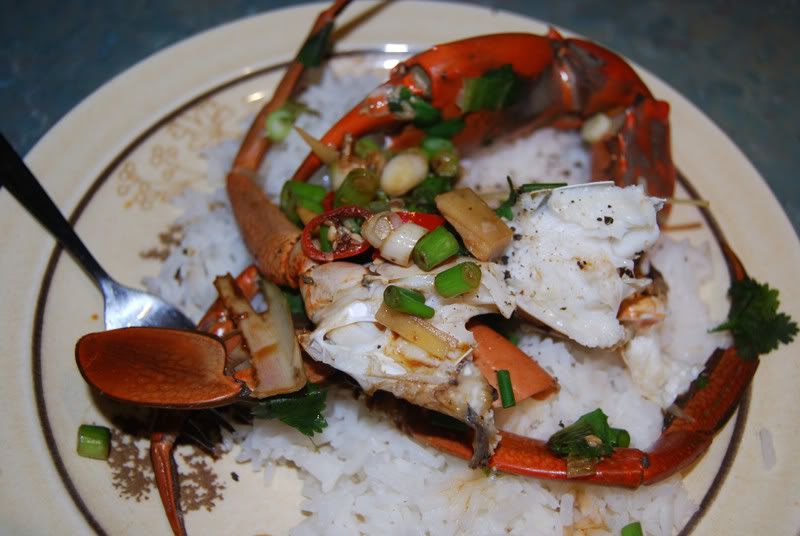
Thai mud crab


Never had mud crab before this. Had blue swimmer, had spanner. Didn't mind the former but wouldn't bother with the latter again. I was convinced that crab was inferior to bugs, yabbies, prawns and lobster, but still, I'd heard good things about mud crab and felt that I had to give it a go.

You might have to extend the cooking times. The crab I bought was about 600 g. A bigger crab would require a few more minutes, probably. You could use this recipe with other crabs. With blue swimmers, even. Just adjust the cooking time.


Ingredients:
1 live mud crab, about 600 g
4 cloves garlic, minced
3 stalks lemongrass, torn up and bruised
2 small chillies, sliced
1 big lump of ginger, sliced
1 bunch spring onions, sliced
1/2 bunch fresh coriander, leaves picked
a splash of soy sauce
a pinch of brown sugar
steamed rice, to serve

The best way of dealing with the crab is to sit it in the freezer for a hour. If he's not dead by that point, he'll be pretty groggy.

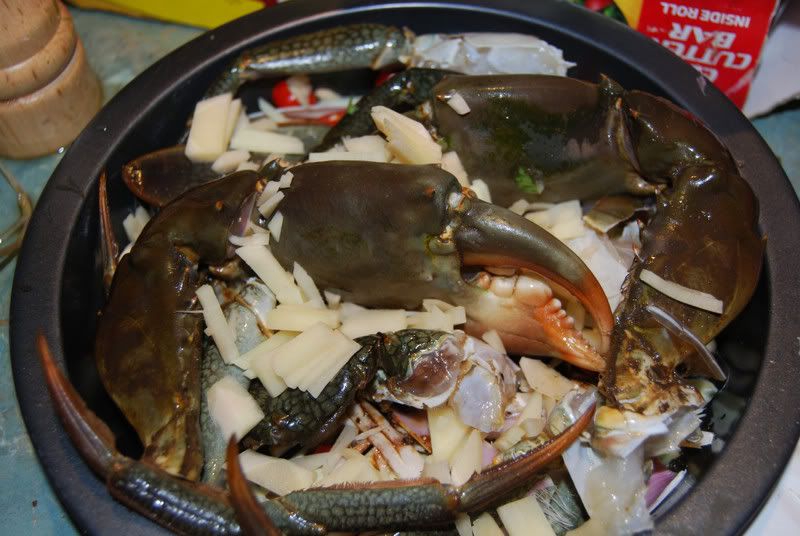
Heat a large saucepan of water on the stove. Sit an appropriately sized bamboo steamer over said saucepan. Meanwhile, take the crab from the freezer. Flip him onto his back and pull at the flap on the belly, ideally working off the shell in the process (if you balls it up, you can just bust the shell open with a sharp knife). Pick out the lungs--those grey, furry things--and get rid of the mustard-looking stuff. Pretty much, with a crab, the inedible stuff looks inedible. Twist the legs and claws off. Give the claws a good whack with the back of your knife, a meat tenderiser, a sharpening steel or pretty much anything to crack them open.


On a small metal plate (I actually used a small pie tin), make a bed for the crab pieces with the lemon grass. Scatter the garlic, ginger and chilli over the crab pieces. Sprinkle over the sugar and add the soy. Don't go nuts with that stuff, as it's pretty potent. Steam for 15 minutes or until the crab is cooked through--the shell will be bright red. Lift the lid of the steamer and scatter the coriander leaves and spring onion slices over the crab. Steam for a further minute. Serve with rice.

Thursday, January 22, 2009

The post-crab feast smell

I don't know about you, but I find the stench crabs leave in a stock pot after cooking rather offensive. Never fear, there is a way of dealing with this smell and it is very simple. All you have to do is give the stock pot a wash, then fill it up with water. Squeeze in some fresh lemon juice. Throw the lemon wedges in too. Put the stock pot somewhere out of the way so no 'helpful' soul decides to empty it. Leave overnight.

Friday, January 16, 2009

Simple, perfect calamari

Generally, I don't go for deep-fried foods. I mean, okay, a bowl of good, hand cut frites is one of my favourite things in the world. But when it comes to meat and seafood? I don't want my fish fillets deep-fried. I don't want my chicken drumsticks deep fried. And I certainly don't want my calamari deep-fried. Personal taste and all, I guess.

I pan fry or barbecue my calamari and I urge you to try doing the same. This recipe is based upon a River Cottage recipe, so props to Hugh Fearnley-Whittingstall for the idea.

The secret with calamari is to not overcook it. I mean, I can't emphasise this enough. Prepare squid the right way and it'll be amazingly tender. Overcook it even a little and it'll be tough. Inedible, even.

Ingredients:

1 fresh squid
2 cloves garlic, finely minced
2 small chillies, finely diced
1 lemon, quartered
freshly ground black pepper
oil

Prepare the squid by chopping off the head. Discard the beak. Hang on to the tentacles--you can fry or barbecue them too and they'll be lovely, so long as you don't overcook them. Please.

Carefully open the body with a knife and lay it out flat. There might be a large sack of goo--that means the squid was knocked up, I think--which should be discarded. Use a paper towel to remove the thin, clear membrane from what used to be the body's internal wall. Cleaning squid is a quicker and easier process than cleaning fish (supposing you clean your fish dry).

Once the squid is clean, use the tip of a sharp knife to score a criss-cross pattern into one side of the flesh. Be careful. Be gentle. You're not trying to slice the poor thing into ribbons here. The goal is to make 'trenches' in the flesh that will catch the pieces of chilli and garlic.

When the squid has been scored, cut it into thick strips. Rub the chilli and garlic and freshly ground black pepper into the 'trenches'. Smear the squid with a little oil and place in the fridge, covered, for a hour or two to let the flavours develop.

Pre-heat a pan or barbecue to really hot. 'Really hot' as in smoking hot--the same temperature you'd get it to if you wanted to give a piece of steak a lovely, crispy coating. Place the squid pieces, scored side up, into the pan. Squeeze lemon juice over them. After 45 seconds, flip them over. Squeeze lemon juice over them. They'll start to curl up. After 45 seconds, flip them over again for 30-45 seconds, ensuring the part that curled cooks properly. Squeeze lemon juice over them and remove from the pan.

Thursday, January 15, 2009

Fishy smells and slime - a buyer's guide

Looking at my StatCounter page, I'm surprised at the amount of people Googling for things like, 'My steamed crab tastes like ammonia. That's okay, yeah?'

So. Some tips. Raw seafood should smell like the ocean. Fish, prawns, crabs and their brethren should look as if they've just been taken from the water. You've been fishing, right? Freshly caught fish don't smell overly 'fishy', do they? Fish bought at the shops shouldn't either. And they certainly shouldn't smell like cleaning products. Fish shouldn't be slimy, either.

I don't know about where you live, but I live close to a few fishmongers. If I ever walk in to a place and instantly feel my stomach turn because the place reeks to high heaven, I turn around and leave. Forget what the sales assistant says. If the seafood that's on display has a really strong smell, it's not fresh. Don't waste your money. Find another fishmonger.

In the case of crabs, lobsters and other crustaceans, try and find a fishmonger that sells them live. When crabs and lobsters die, they rapidly decompose. Something you kill immediately before or during the cooking process will taste better. Too, when you buy something live, you know it's fresh. When buying live crabs and lobsters, look for the ones that are really feisty. If they're just sulking at the bottom of the tank, pick another. Lobster and crab aren't cheap, generally, so be fussy. If a fishmonger is only selling rubbish, he doesn't deserve your money. Don't be so fixated on the idea of having lobster for dinner that you ignore the tell-tale signs of poor quality.

With prawns, buy whole, uncooked prawns. Buy whole fish in generally, really. It's easier to see if it's fresh. The eyes should be clear. And yeah, as I said, the fish should look as if it's just been pulled from the water. Note that some fishmongers will sell live fish--'live' as in they'll kill it to order. That's maybe the best way, aside from catching the fish yourself, of ensuring what you're buying is fresh.

With oysters, only buy them if you see them being shucked on site. Oysters will keep for about a week in the fridge, but they're better when they're freshly shucked. In the ideal world, you'd buy an oyster knife and learn to shuck them yourself.

Too, if you live in an area with a lot of oriental immigrants, consider yourself blessed. The Japanese, Chinese and Vietnamese eat a lot of seafood. There should be a lot of places catering to that market. Pay attention to what the grandmothers buy. If you see a few old biddies take one look at the snapper and walk away, shaking their heads in disgust, it's probably best to follow their lead and avoid the snapper.

There are too many terrible fishmongers around, foisting rubbish onto unsuspecting and ignorant customers. Whether you're intending on buying cheap, 'trash' fish like skate or premium stuff like lobsters and mud crabs, you must be fussy. Don't accept rubbish. If you get burnt by a business, don't give them a second chance. Surely someone else is more willing to provide you with quality produce.

Unless you're buying frozen seafood, when you buy is important. Never buy seafood on a Sunday, Monday or the day after a public holiday. Fishermen work from Monday to Friday. Friday's catch arrives in stores on Saturday morning. Therefore, what you buy on Monday arrived in store on Saturday morning. Yes, I know, some seafood--mussels, say--lasts 'a while' in the fridge, but the quality quickly deteriorates. As a rule, buy fresh seafood only on the day you're intending on using it.

When it comes to handling seafood, perhaps the most important thing to remember is to not wet the seafood. The last time fish should come into contact with water, unless you're poaching, is when they're taken out of the river or the sea. When filleting and gutting a fish, you should do it dry. Cleaning a fish the dry way is a slower process, but it produces better results. Washing out the gut cavity gets rid of all the natural oils in the fish's flesh. And those oils are flavour. Be wary of fishmongers who, when asked to clean a fish, hold the poor thing under running water while they work.

When pin boning fish fillets or cutlets, it's important to use tweezers. Your fingers will simply make a mess of the job. Dedicate a pair of tweezers to the task or buy a specialist pin boning tool. Some fish mongers may take care of this task for you.

Don't write off seafood that's frozen or somehow preserved. Crocodile, while arguably more game meat than seafood, is always sold frozen. Scampi is generally sold frozen. And it's fine. Really. Too, put aside your experiences with the canned seafood you've picked up in supermarkets in the past, as canned tuna from Spain is very good and works well as a filling in savoury pastries. Indeed, this is the same canned tuna used in tapas bars in Spain. That being said, most canned seafood is rubbish.

Friday, January 9, 2009

Curried Morton Bay bugs

Morton--sometimes spelt as Morten--Bay bugs are my favourite crustacean. Easy. The meat-to-shell ratio isn't too bad in comparison with, say, scampi and crab. The flavour is tops. And too, in Melbourne, where the bugs aren't as popular as they are in Sydney, they're reasonably affordable. I picked up a few on special today and figured I'd make a curry with them.

Photobucket

Of course, if you're not from Australia, you probably don't have access to bugs at all. I'm not sure if we export them, but if we do they'd probably be ridiculously overpriced. Feel free to substitute the bugs with a crustacean of your choosing--scampi, prawns, crayfish, crab, whatever. Keep in mind you may need to adjust the quantity of gravy and cooking times if you're using something other than bugs. This recipe makes enough for two people.

Ingredients:

8 Morton Bay/Balmain bugs (12 if they're small)
200 mL can coconut milk
2 cloves garlic, peeled
1 large shallot, peeled
1 small lump of ginger, peeled
1 piece of tamarind* that's about the size of your thumbnail
1 small lemon, juiced
1/2 tsp chilli powder
1/2 tsp freshly ground coriander
1/2 tsp cumin seeds
1/2 tsp poppy seeds
vegetable, sunflower or peanut oil
steamed rice, to serve

Place the piece of tamarind in 100 mL hot water and set aside.

Combine 100 mL of the coconut milk with 200 mL water. Leave the other 100 mL undiluted.

Blitz the spices, garlic, shallot, ginger, lemon juice and 1 tsp water in a food processor. This will be your curry paste.

Extract the meat from the tails of the bugs by twisting the tails off and then breaking a couple of tail segments with your fingers or the tip of a knife. If you do it right, you'll be able to pull the meat out in one piece.

Heat a generous splash of oil in a small saucepan over a low flame. When hot, add the curry paste and fry for five minutes. Add the diluted coconut milk. Stir. Cook for fifteen minutes. Pluck the tamarind piece out of the water it was soaking in. Don't worry if there's a little bit left behind. Pour the water, along with the undiluted coconut milk, into the saucepan. Cook for a further fifteen minutes before adding the bug meat. Simmer for a couple of minutes or until cooked through.

Use a pair of tongs to fish out the bugs and distribute them evenly atop two piles of steamed rice. Spoon over the gravy and serve.

Photobucket

* Tamarind can be found in Indian and Sri Lankan grocers. You can buy it in concentrate form, but in this recipe we're using a bar. In my local places, at least, tamarind bars are sold near the spices. They're about the size of a small block of chocolate and look, well, kind of nasty. Like they're mouldly. Feel free to substitute the concentrate for the bar, but be careful--the concentrate is really potent stuff, so you'd only want to use the tiniest amount.

Tuesday, January 6, 2009

Portuguese chicken pizza

Following on from yesterday's post about making the perfect pizza base in a domestic oven, I figured I'd provide a suggestion for a topping combination. Remember that pizza has few rules. Once you perfect the base, you're free to experiment with the toppings. I mean, just because the local takeaway doesn't put a particular ingredient on a pizza doesn't mean you can't.
The recipe for the perfect pizza, along with the associated 'rules' for pizza making, can be found here.

Ingredients:

1 ball of pizza dough (see original article)
75 mL tomato passata (aka sugo)
5 balls of boccocini cheese, sliced
4 anchovies, cut into pieces
3 cloves of garlic, minced
1 chicken thigh, cubed
1 onion, sliced
1 lemon, juiced
1 fresh chilli, diced with seeds removed
1 tbs chilli powder
handful sun-dried tomatoes
sea salt
freshly ground black pepper

Marinate the chicken cubes overnight or at least for a few hours in the chilli powder, lemon juice, sea salt and black pepper. Fry until cooked through and set aside to cool.

Pre-heat the oven to 230*C for a good twenty minutes, as per usual. When ready to cook, remove stone slab/oven tray from oven and drop the oven temperature to 200*C. Roll the base out directly onto the slab/tray, dusting the slab/tray with corn flour if you feel it necessary. Roll the pizza base about 7 millimetres thick. If you roll it too thin, it won't come out as well as it should.

Combine tomato passata, diced chilli minced garlic. Spread the passata over the pizza. Distribute the sliced boccocini cheese evenly across the base. Top pizza with chicken, sun-dried tomatoes, anchovies and onion. Bake pizza for 20 minutes or until base is crispy and golden.

Monday, January 5, 2009

Steamed crabs with a simple lemon and pepper dipping sauce

Last night, I put together a crab curry with spanner crabs. I was disappointed. Spanner crabs, it turns out, have a worse meat to shell ratio than crabs I usually buy, the humble blue swimmers that readily available in about every Melbourne fishmonger. And too, the flavour of the gravy dominated the flavour of the meat. And yeah, I managed to stab myself on one of the crab's spines. So, yeah. Crabs. I like them, really, but only when they're prepared the right way. I've prepared them a few different ways now and, honestly? I really dig the way I first did them, when I first had them myself one Saturday with the kids. Whole lot of fun, that was.

Now, to cook crabs, I recommend steaming. The flavour of steamed crab is superior to that of boiled crab. I steam with salt water, but there's nothing stopping you using white wine or vermouth. Some folks use beer. I understand that flat beer imparts a better flavour. The best way to flatten beer is to pour it into a bowl and leave it to sit for a hour or so at room temperature.

So. Crabs. Buy the freshest ones you can get your hands one. The best way to ensure freshness is to buy live crabs, but sometimes the fishmongers don't have those or they're too expensive. So long as the blue swimmers at your local fishmonger have been killed recently, they'll be fine. Heck, ask your fishmonger if he can get some live ones in specially for you. He might be able to hook you up. Whether you buy male or female crabs is up to you. Female crabs sometimes have eggs. Male crabs are generally larger.

To steam the crabs in water, pour water to a couple of inches deep into a stock pot. Add salt until the water tastes like sea water. Crank the heat, bring up to the boil, add the crabs legs-up and jam the lid on. If using white wine or vermouth, heat the pan fry. When smoking, add a couple of inches of wine, add the crabs legs-up and jam the lid on. The general rule with crabs is to cook them for 15 minutes for the first 500 grams, followed plus an additional 10 minutes for every additional 500 grams. Now, that's just a general rule. The best way is to keep an eye on the things. When they're bright red all over, they're cooked. Pour the contents of the stock pot into a colander and hold the crabs under cold, running water. Not only does this arrest the cooking process, but it also makes them easier to handle and loosens the shell.

To deconstruct a crab, grab the claws at the base and give them a good twist to separate them from the body. Twist the legs off in a similar fashion. Somewhere on the underside of the crab you'll see a flap. Pull it towards you. Do it right and you'll take the top shell away with it. If you bugger it up, it's possible to prise the shell open with a knife in the same way you'd shuck an oyster.

Most of a crab's internals are edible, although you need to keep an eye out for small pieces of clear membrane amongst the meat. The only pieces you really can't eat are the stomach sac that's immediately behind the crab's 'face' and the grey, finger-like things on the crab's belly. I believe they're the lungs. Be sure to throw them away. Do hang onto the shell if you intend to knock up some seafood stock in the near future, though.

Eating crabs is meant to be a hands-on experience. Rather than taking all the fun out of it, simply serve your guests the claws and legs whole (although it is a good idea to crack the claws first--I used a meat mallet to do that). So far as hands-on lunches go, you really can't beat sucking crab meat from the legs and claws.

Oh and the dipping sauce. I almost forgot. This one can be whipped up while the crabs are steaming. It was shown to me by a Vietnamese friend. She simply squeezed the juice of a couple lemons into a bowl and gave it a liberal grind of black pepper and sea salt before mixing well with a fork. If you wanted to be creative, I suppose you could add a little fish sauce or chilli sauce. No need to be too fancy.

Crocodile in coconut milk

Crocodile meat is quite mild in flavour. A bit like chicken. A bit like firm, white fish. Cook it incorrectly and it'll be tough as a roadside shoe. Cook it correctly and it's wonderful. This gravy, simple as it is, can be used for chicken and various kinds of seafood.

Where to get crocodile, you ask? Well, you could try a butcher or poultry store. Ask them to order it in. Or you could do as I do and hit an oriental-owned and operated fishmonger--especially one that specialises in frozen produce. Crocodile is always sold frozen. Most will sell crocodile steaks for a reasonable price.

Ingredients:

800 gram crocodile steak, cut into thin strips
300 mL coconut milk
2 shallots, diced
2 cloves garlic, crushed
2 red chillis, finely diced
1 lime, juiced
small lump of ginger, grated
1 tsp fish sauce
a couple of sprigs of fresh coriander, leaves picked
a couple of sprigs of sweet (Thai) basil, leaves picked
steamed rice, to serve

Heat a little oil in a fry pan over a low-medium flame. Fry shallots, garlic, ginger and chillies until they start to soften, then add the crocodile. Fry, stirring constantly, for 4-5 minutes before adding the coconut milk, fish sauce, sweet basil leaves and coriander leaves. Bring to boil then reduce heat and simmer for 2-3 minutes. Squeeze in the lime juice and give a final stir

Sunday, January 4, 2009

Simple sushi rolls

Really good sushi is, well, really good. What makes really good sushi? Well, of course the fish has to be of good quality and fresh. And too, it has to be seasoned just right. And it has to be freshly made, so the nori--that is, the seaweed wrapping--remains crisp.

Now, you'll notice I don't specify sashimi-grade fish here. If you can get that, then by all means go nuts. But for the average person, any nice piece of fish will do the job. The term 'sashimi-grade' fish refers to how the fish was killed and stored. It's perfectly okay to use regular fish for sushi or sashimi. Indeed, I suspect many of the cheap sushi places around wouldn't use the expensive, sashimi-grade stuff.

I use salmon because raw salmon is one of my favourite things in the world. Feel free to use about anything else. If the fishmonger is telling you his tuna is really good today, then yeah, go for that instead. Anyway, with the salmon, I don't buy those cutlets. I get a fillet and pin bone it using a pair of tweezers. Invest in a dedicated pair of tweezers for pin-boning fish if you haven't already, as doing it by hand is a real pain.

To begin, steam some jasmine rice as normal. For a enough sushi for two people, I used two thirds of a cup of jasmine rice to just under one and a third cup of water. I added a little salt and brought it to a boil slowly, then dropped the heat and covered for twenty minutes. At the ten minute mark, I turned the heat off altogether. At the end of the twenty minutes, I removed the lid and fluffed it with a fork, before slowly adding some pre-mixed sushi seasoning (I picked up Mizkan brand from the local oriental grocer and it seemed okay), tasting and stirring as I went. I left the rice to cool while I prepared everything else.

I slice the fish about a centimetre thick. Too thin and it'll fall apart. I also julienned a spring onion and poured a little light soy sauce into a Chinese tea cup. Once the rice was about body temperature (about 37*C), I placed a sheet of nori on the bamboo sushi mat I'd picked up for all of a dollar. On top of the nori, I smeared a fairly thin layer of rice, although I left part bare.

Next, I layed, end to end, strips of spring onion. Then I took my finger and dipped it in the soy sauce. I smeared the sauce in a very thin film on one side of the fish. Be careful with soy sauce--use too much and you'll destroy the lovely flavour of the fish. Using your (clean) finger tip is perhaps the best way of applying it in this situation. I played the fish, soy side down, next to the slivers of spring onion. I put a few dots of wasabi paste on top of the fish. Never combine wasabi and soy sauce. And be sparing with the wasabi--people can add more later if they want, but if you use too much in the beginning you'll overpower the flavour of the fish. Finally, roll the sushi. Some people claim to have had trouble with this part, but for me it seemed simple enough. So long as you don't over pack it or use too much rice, you'll be fine. Eat as soon as possible, as it won't be long before the nori goes soggy.

Meat and etc

Hi

About everyone who knows that I like trying stuff, particularly stuff that was once part of an animal. Meat and seafood. It's all good. Never met an animal I haven't liked and all that. Anyway, one of the kids at work, this eleven year old boy, he recently asked me to compile a list of the meat and seafood I've tried. This is the e-version. I'm working for memory here, so maybe I'll miss a couple. And yeah, technically I kind of double up in some places. I know that veal is just baby cow, that lamb is baby mutton, but they are sold as different meats. And they do taste different. So, without further ado:

Anchovies
Baramundi
Beef
Blue grenadier
Boar
Buffalo
Camel
Chicken
Crocodile
Duck
Emu
Goat
Goose
Guinea fowl
Hake
Kangaroo
Lamb
Lobster
Morten Bay bugs
Mullet
Mussels
Mutton
Octopus
Ostrich
Oysters
Pheasant
Pigeon (both squab, which is baby pigeon, and elderly boiler pigeon)
Pork
Prawns
Quail
Rabbit
Salmon
Sardines
Scallops
Scampi
Shark
Shearwater (muttonbird)
Silkie (black chicken)
Snails
Snapper
Squid
Trout
Tuna
Turkey
Veal
Venison
Wallaby
Yabbies (freshwater crayfish)

With the fish, I'm just going from memory. Probably I've missed a few. A lot, even. But oh well.

The perfect prawns


I've seen a lot of prawn recipes that are very elaborate. And that's unfortunate as, really, prawns are nice enough to stand up on their own. So long as you buy good ones, I mean. Or have the facilities and the opportunity to catch them. So far as I'm concerned, you shouldn't bother working with prawns unless you can get fresh, local produce. Buy them on the day you plan on cooking them. Don't buy them on days when there's no way they could've been brought in fresh, like Sunday and Monday or after a public holiday. Don't buy the pre-cooked ones. They're rubbish. Don't buy the pre-shelled ones, either. They're terrible. When you're making a dish that only has a couple of ingredients, when you're allowing the ingredients to speak for themselves, the quality of your purchase is immediately apparent the moment you start eating. I mean, recently, a friend dropped by with a pile of prawns he picked up from one of the big supermarkets. In terms of freshness and quality, they paled in comparison to the prawns I picked up for less at one of the nearby Vietnamese fishmongers. Clearly, the customer base of the fishmonger is fussier than that of the average supermarket. Particularly during the summer holiday period, when many people are barbecuing.

So, yeah, buy good prawns, is the point. They need not be the most expensive, but they look and smell fresh. They shouldn't be all battered, physically. And they shouldn't smell too bad. If they smell kind of like a cleaning product, like ammonia, then refuse to buy them. If they smell really, really, really fishy, then yeah, don't buy them. If you're like me and live in a multicultural area, you'll probably have many butchers, fishmongers, delis, green grocers and spice stores within a reasonable distance of your home. Or if you live near one a fresh produce market, the same advice applies. Shop around.

Too, while you're out shopping, pick up some lemons. Seafood and lemon juice are a timeless and winning combination.

To prepare the prawns, take a sharp paring knife and drip the tip into the shell just behind the head. Carefully work your way along the prawn's 'spine' until you reach the tail. Now, gently pull the prawn open. You'll see an intestine. If the prawn's eaten lately, it'll be dark. Other times, it'll be a very pale green. It's very important you fish out the 'poo tube', as it does have a significant and negative impact on the taste of the flesh. Once you get used of the process of removing the 'poo tube', you'll be able to work your way through even a large pile of prawns in no time. This can be done ahead of time. Removing the 'poo tubes' of larger prawns is much easier than removing the 'poo tubes' of smaller prawns, so keep that in mind when shopping.

Place the freshly gutted prawns in a shallow bowl of olive oil. You can, if you want, add a crushed clove or two of garlic to the oil (remember the garlic oil will be even more flavoursome if you allow the garlic cloves to infuse in the oil overnight before adding the prawns). Cut the lemons into wedges. You're going to need them very soon.

When you're ready to cook, pre-heat a barbecue, grill pan or fry pan until the smoking point. Seriously, if you're using a pan, pre-heat it for a good five to ten minutes. Then add your prawns. Now, if you have a large amount of prawns, add only a few at a time. If you crowd the pan, the temperature will drop. Immediately squeeze lemon juice all over the prawns. Cook for maybe 45-60 seconds. Working quickly, flip the prawns over and squeeze more lemon juice over them. After 45-60 seconds, remove the prawns from the pan and place them on a serving platter.

And that's it. You can experiment, of course. If you really wanted, you could jam a thin sliver of chilli into the back of each prawn. You could add roughly chopped fresh parsley to the marinade, as they do in the MoVida cookbook. But whatever you do, keep in mind the whole point of the exercise is for people to be able to appreciate the lovely fresh prawns you've picked up. The last thing you want to do is to kill the flavour with a strong sauce or dressing.